

Reading food labels can be tricky.
Today, more than ever before, the general public is health conscious and scrutinizing the food they purchase.
Food manufacturers and marketers know this.
So you come across a snack that says “light” or “multigrain,” and you assume the product in it is healthy.
Why would they lie?

There’s nothing worse than finding out your favorite protein bar is actually just a sugar filled candy bar with deceiving packaging.
That’s why today we are dedicating an article to seeing through this deceptive marketing.
We’ll do this by showing you how to read a nutrition information panel, as well as what packaging claims you can dismiss as bogus.
We’ll also give you some tips on shifting your diet to a more healthy way of eating in general.
If you are trying to watch what you eat to lose weight, make sure you grab our healthy eating guide: 10 Levels to Change Your Life.
It’s a level up system, with each step shifting you towards improved nutrition strategies. We take it slow and work with your own pace, so the changes you make will be sustainable and permanent.
You can download our 10-Level Nutrition Guide when you sign up in the box right here:
- Follow our 10-level nutrition system at your own pace
- What you need to know about weight loss and healthy eating
- 3 Simple rules we follow every day to stay on target
IGNORE THE FRONT OF THE PACKAGE
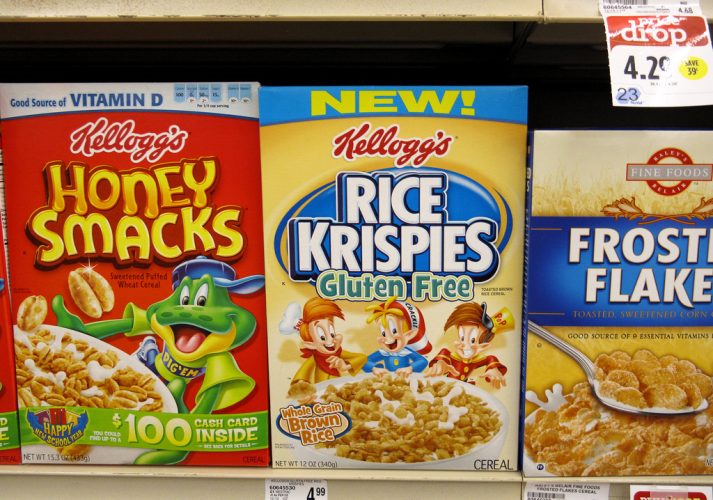
Food manufacturers are not required to place any nutritional information on the front of the package.
Because of this lack of regulation, what’s included on the front of the package is what the manufacturers want you to see.
In other words, sales propaganda.
Let’s take a look:
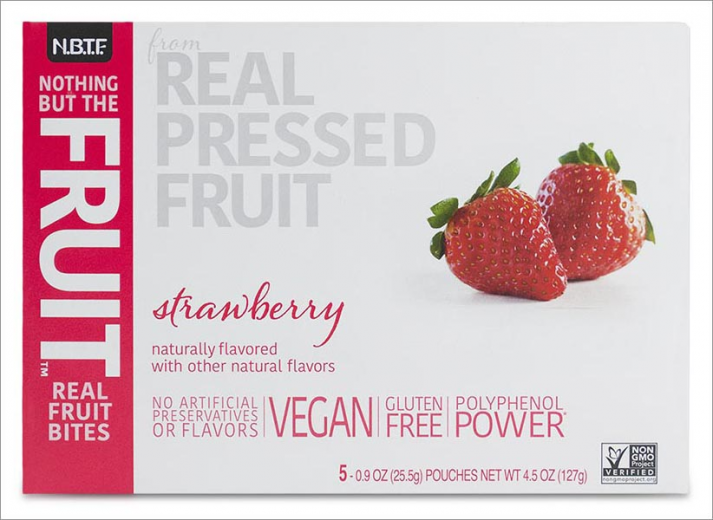
“Real Fruit Bites” is the product and the company is Nothing But The Fruit.
From the looks of this, I would assume these “bites” are mostly made of strawberry? Because what else would you put in them?
The verdict: the number one ingredient in this is “apple puree concentrate.”

I’ll devote an entire section to bogus health terms marketers use to fool us shortly. I bring up the front of the package now, to tell you it’s not where the real info is.
If you want to know exactly what you are eating, you need to look at the Nutrition Label and Ingredients List.
That’s where food marketers have to tell the truth (sort of).
WHERE THE REAL HEALTH CLAIMS OF A FOOD LABEL CAN BE READ
In the United States, the Food and Drug Administration (FDA) requires most packaged food to include a label.
Many other countries around the world have a similar agency regulating food.
This is key for us nerds because organizations like the FDA force companies to disclose exactly what’s in the food they’re selling.
They do this with a Nutrition Label and an Ingredients List.
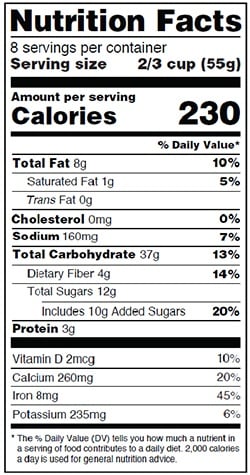
A Nutrition Label identifies the nutrients found in a portion of food, like calories, protein, and vitamins. It’ll look like something like this:
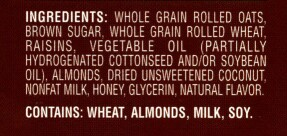
An Ingredients list tells you what they placed into the product to get those nutrients.
It might look like this:
Both are important to analyze.
You want to know how many calories you’re getting out of your meal, which can be found in the Nutrition Label.
You also want to know what foods they are using to make up those calories, which can be found in the Ingredients List.
HOW DO I READ A NUTRITION LABEL

Let’s look at another Nutrition Label:
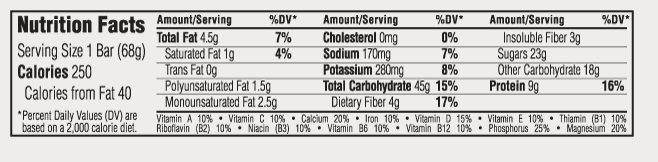
This is taken from a Spiced Pumpkin Pie Cliff Bar.
Let’s analyze:
Serving Size. This is somewhat self-explanatory: serving size is the amount of food, by volume or weight, that is considered one “serving.” New FDA regulations require this size should be typically what someone would eat in a single serving. Which matches what we see here, with “1 Bar.”
However, double check this. Your serving might not match what the manufacturer has in mind. For example, a bag of Doritos has about 10 servings in it.
Do you really only eat a tenth of bag of Doritos at a time? Look at the Nutrition Label.
Calories. This is the energy you’ll get from food.[1]
This will be one of the most critical pieces of information on the food package. Which is why it’s right under the serving size on the label.
Going back to our Cliff Bar example, we can see that one bar is roughly 250 calories.
I want to talk about that word “roughly.” The FDA allows a 20% leeway in either direction for food manufacturers. That means, legally, that Cliff Bar might have 200 calories…or 300 calories.
%DV. Have you ever wondered what that “%DV” stands for? It means “Daily Value” and the percent will range from 0 to 100.
%DV is an estimate of how much of a particular nutrient you are eating with one serving of food. For example, if you ate that Spice Pumpkin Pie protein bar, you would be getting around 8% of the potassium required for a healthy diet.
However, we need to explain come caveats: it’s based on a 2,000 calorie a day diet, whereas the average person needs more than this (calculate your calorie needs here).
Also, this is the FDA’s estimate of how many vitamins and minerals you need. Do you really trust Big Brother? Use %DV as a starting point only.
Here’s some rough guidelines:
–Less than 5% DV isn’t that much.
–More than 20% DV is a lot.
You’ll notice that some things, like Trans Fat, Protein, and Sugar don’t have %DV. The FDA doesn’t require this information, so most food sellers don’t include them.
Don’t overlook the Nutrition Label. Yes, they are estimates. But an estimate of the number of calories in a meal is better than no estimate, especially if your goal is weight loss.
A message I really strike home in our “Why Can’t I Lose Weight?” article is having a good estimate of calories in and calories out. While there is plenty of nuance, weight loss really does come down to calories eaten and expended.
That’s why reading the Nutrition Label can be so critical – it helps you with the first part of this equation.
If you have no idea how many calories you need to eat in a day to reach your goals, I have a couple of resources for you.
The first is our article “How Many Calories Should I Eat Every Day?” It includes a calculator to give you an estimate of your individual calorie requirements, plus tips on what to do with this info.
And the second is for people who are looking for more specific, guided accountability, our uber-popular 1-on-1 Coaching Program. We take all the guesswork out of a weight loss plan and help you start to make better food choices.
We’ll tell you exactly what you need to do to get in shape, by changing your nutrition strategy, creating an exercise program, and offering personal accountability. Many Rebels have turned their lives around by becoming a client, and we’d be happy to talk with you to see if we could be a good fit for each other.
Click on the big image below to learn more:

WHAT NUTRIENTS DO I WANT MORE OF? WHAT NUTRIENTS DO I WANT LESS OF?

Let’s chat quicky about some of the nutrients identified on the label.
We’ll first talk about dietary fat: the good, the bad, and the ugly.

The terms “saturated” or “unsaturated” refers to the bonding of hydrogen atoms to carbon atoms in a fat molecule. When every carbon molecule is bound to the maximum number of hydrogen atoms, the fat is “saturated.” If some carbon molecules are double-bonded to each other (and bonded to fewer hydrogen atoms), the fat is “unsaturated.”
Let’s chat about why this matters.
The good: unsaturated fat. This is the “healthy” type of fat. There are two types, monounsaturated and polyunsaturated (don’t worry too much about the difference, it has to do with the number of carbon double-bonds in the molecule). Unsaturated fat is typically liquid at room temperature, and you find it in plant-based products (like nuts, avocados, coconut, etc). When people talk about “healthy fats,” unsaturated is generally what they are referring to.
What about saturated fat? There’s a lot of conflicting studies out there on saturated fat, and it’s been vilified by marketing companies for years. So what’s the truth? Personally, I believe that saturated fat is an important nutrient that we need in our system. You can check out this article for an interesting debate on the subject.[2]
The bad: trans fat. There has been a good deal of hype about trans fat in recent years. So what’s the deal? Trans fat is technically an unsaturated fat, but the fat molecule has a different type of carbon double-bond that gets created when oil is “partially hydrogenated.” Hydrogenation is a process used in food production to increase shelf life, which is why it’s often found in processed food like frozen pizza and doughnuts. Why does all this matter? The “trans” type double bond causes the fat to behave differently in the body, and NOT in a good way. Trans fat can contribute to atherosclerosis, which could lead to a heart attack. Keep your intake of trans fat as low as possible.[3]
It should also be noted, that if food has less than 0.5g of trans fat per serving, the FDA allows food manufacturers to round down – meaning “0.” So even if the packaging says “Zero Trans Fat,” it might actually still have some.[4]
We’ll end this article by talking about ways to avoid this concern, by sticking to “real food.”
Cholesterol is the next big player on the list. Cholesterol is an important building block in cell membranes. We get some from food, and some is made in our liver. Cholesterol is mainly found in animal products, just like saturated fat. In my opinion, cholesterol is not the villain it’s made out to be!
Sodium, and often Potassium, are also listed in this part of the Nutrition Facts label. These are electrolytes. Should you avoid sodium, because of a possible increase in blood pressure? Eh, the findings on this are mixed.[5] A little bit of salt on your food (or in your food) should be fine.
Carbohydrates include simple carbs (sugars, like glucose, fructose, dextrose) and complex carbs (fiber and polysaccharides).
Dietary fiber is great stuff! There are two types: Soluble fiber is digestible and gets absorbed by your body. This type of fiber helps keep your blood sugar levels stable.
Insoluble fiber is not digestible, so it stays in your GI tract and helps “keep things moving.” Trust me, this is a good thing.
Prioritize fiber in the foods you eat.
Sugar is a simple carbohydrate. It can be absorbed by your gut very quickly because it doesn’t need to be broken down by enzymes first. Sugar is not necessarily bad for you, but consuming large amounts of sugar can cause your blood sugar levels to become unstable.
Other Carbohydrates generally refers to complex (large) carbohydrates in food, such as starch. These large molecules are broken down by enzymes into sugar, but the process takes a while. Complex carbohydrates keep your blood sugar levels more stable than do simple carbohydrates.
Protein is one of the main building blocks for muscle and other body tissues. There is normally not a %DV for protein because the amount of protein that each person needs is quite variable. You can check out this article for an idea of how much protein you should be eating.
At the bottom of the Nutrition Label, you’ll also see a breakdown of micronutrients.
Let’s go over some of these key players:
Calcium: needed to build bones. This is especially important for women, because bone mass decreases after menopause, so build your bones strong while you are young!
Vitamin D: needed to aid the absorption of calcium. Some of this comes from food, and some is made by your body when you are exposed to sunlight.
Iron: needed to make hemoglobin, the oxygen-carrying substance in blood cells. Women are more at-risk for being iron deficient, while men are more at-risk for being iron overloaded.
You may notice that some labels list more micronutrients than others. If a micronutrient is missing from a label, that means there is not any of it in the food product.
Let’s look at the Nutrition Facts for a can of soda.
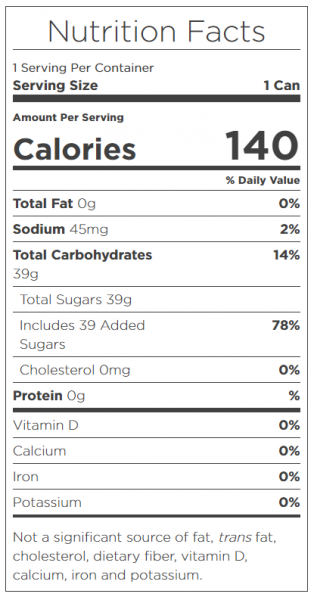
See any micronutrients on there? That’s why soda is referred to as “empty calories.”
HOW DO I READ AN INGREDIENTS LIST?

Let’s take another look at our Cliff Bar, but this time, looking at the Ingredients List:

All the ingredients are listed in order of quantity by weight, so the first few ingredients make up most of the product.
For example, the Spice Pumpkin Pie Cliff Bar is mostly brown rice syrup (sugar), oats, and cane syrup (more sugar), in that order. The 4th ingredient, “soy protein isolate” is where this protein bar starts to get some of its protein.

I know. Perhaps “Carbohydrate Bar” would be more appropriate than “Protein Bar.”
The first few ingredients will give you an idea of what you’re actually eating. So this Cliff Bar is sugar, oats, and protein from soy.
Pay attention to the ingredients list. This tells you exactly what you’re eating.
Because again, the front of the package can’t be trusted.
BOGUS CLAIMS ON FOOD LABELS TO WATCH OUT FOR

Marketers love the front of food packages.
It’s where they get to use all their fun terms that sound healthy.
Let’s go over some:
“Light.” When you see “light” or “lite” on a package, it means it’s been processed to reduce calories or fat. However, when fat is reduced sugar is often increased to compensate. Check the ingredients list to find out for sure.
“Made with whole grains.” What does “made” mean? It means it contains “some.” Check the ingredients list to see just how much. Is a whole grain in the top three? If not, it’s mostly not whole grains.
“Natural.” This has to be good right? Natural, i.e nature, means good for you?
Eh, it just means that at some point, the ingredients came from a natural source like apples. Going back to our example above, you could argue that the protein bar contained “natural” ingredients because brown rice syrup is derived from rice.
However, a protein bar doesn’t resemble anything grown from a plant. And brown rice syrup really doesn’t have much in common with actual brown rice.
For the most part, the more ingredients on a list, the less natural it is.
“No added sugar.” This sounds good, until you realize that some foods like dried fruit are just naturally high in sugar. Double check the ingredients to find out.
Want some other clever food labels to be on the lookout for? We have a whole article right here diving into the subject.
FOOD WITHOUT LABELS

Want to know how to avoid worrying about Nutrition Labels and Ingredients Lists?
Stick to the outer rim of your grocery store.
You’ll find a lot of the following there:
- Meat
- Eggs
- Fish
- Nuts
- Vegetables
- Fruits
Do you know what most of this doesn’t have? Food labels.
A banana won’t have manufacturer disclosed information, because no one manufactured it.
It’s a banana.

It’s what we here at Nerd Fitness call “real food.”
We discuss this in great detail in our Healthy Eating Guide.
Food that grew in the ground, on a tree, ran on the land, swam in the sea or flew through the air, would fall into this category. Meat, fish, eggs, vegetables, fruits, nuts are all great examples of REAL food.
Most of this food is found on the outer rim of the grocery store. And there aren’t too many food labels here, besides a barcode.
If you want to start eating better, buy whole foods that don’t have food labels on them. They’ll generally have more nutrients and fewer calories, which is an ideal recipe for weight loss.
Then you don’t have to worry about food manufacturers deceiving or trying to hide ingredients.
The banana is a banana.

However, while eating “real food” is a key component of a successful weight loss strategy, it can still be useful to have an idea on the amount of calories in foods such as bananas.
Calories in and calories out is the central component of weight loss (thermodynamics for ya), so having a rough idea of calories you’re consuming is key. Even in “real food.”
Maybe one day we’ll get robot vision to analyze the calories in everything we look at.
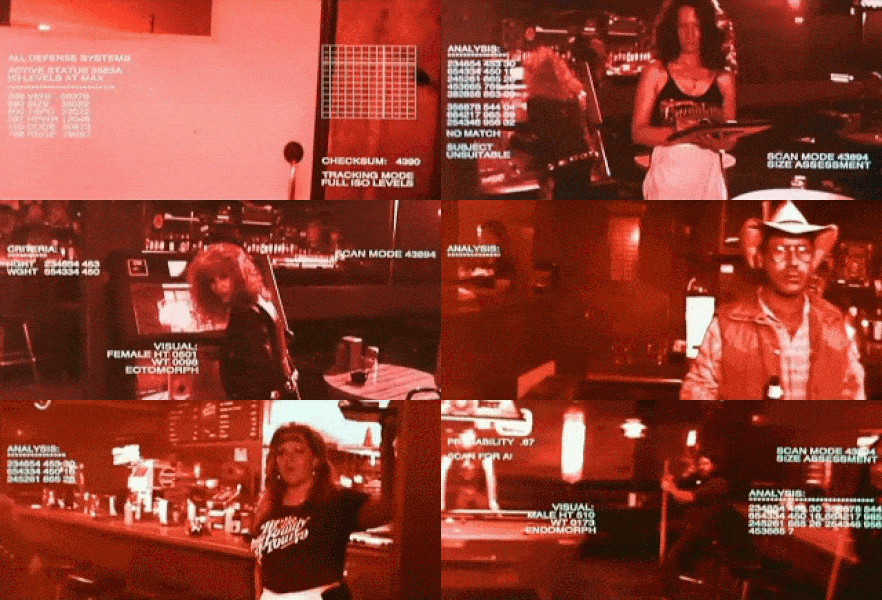
For now, you can Google ‘[food] + calories” or check MyFitnessPal to educate yourself!
Alright, I think that about does it for today’s article on reading a Nutrition Label.
Did I miss anything?
Do you have any tips or tricks on deciphering a Nutrition Label or Ingredients List?
Do you have any other examples of foods that claim to be one thing, but whose ingredient list proves it’s another?
Let me know in the comments!
-Steve
PS: If you’re reading a Nutrition Label to try and lose weight, you’re on the right track! As we state in our Rules of the Rebellion, “You can’t outrun your fork!” Keep at it and keep asking questions!
PPS: If you want more 1-on-1 help to lose weight or shift your nutrition strategy, I’ll again remind you of our Online Coaching Program! We work with busy people just like you to develop and execute plans to level up their lives! Click right here to learn if we are a good fit for each other.
###
All photo sources can be read right here.[6]