Download Our Free Tools
Workouts, nutrition guidance, and habit-building. Never wonder where you should put your limited time, energy, and effort.
Get our FREE Starter Kit with dozens of resources today!

This is an article from NF Rebel Chef Noel.
Last month we covered a recipe that was a bit more advanced for our rebels that love a challenge. This month, we’re getting back to basics and doing something super, duper easy.
My favorite way to eat vegetables is to roast them. The reason I love it is because they get somewhat sweet and crunchy, you can prepare a bunch of them at once. Oh, and did I mention its super easy? Pretty much all you have to do is cut them, toss them in olive oil and spices of your choice, throw them in the oven, and wait.
Now, I said we’re getting back to basics here, so for those who are experienced cooks, this might be more information than you need. If that’s the case, close your computer and bang out some push ups! If you’re new to cooking, then we’re glad to have you.
We’re going to be taking this back to pre-level one. Level 0.5.
Let’s get started!

Basic Roasted Vegetables
Total Time: 45 – 50 min
Serves: 2-4
The great thing about roasted veggies is that you can use whatever veggies you prefer. Here’s what I used:
2 Bell peppers
1 Head cauliflower
1 Red onion
4 Button mushrooms
2 Tbsp olive oil
1/4 tsp salt
Pepper to taste
1. Preheat your oven to 400 degrees F (204 C). Since this is cooking level 0.5, let’s talk about what this means for a second. Preheating means setting your oven to a certain temperature and letting it heat up while you’re getting your ingredients ready.
We may not have readily available hover boards or food hydrators just yet, but we are living in the future. As long as there is nothing spilled in the oven and you don’t leave anything inside it when you turn it on, your oven is safe to preheat ahead of time. It will regulate itself by turning the heating coils or burners inside on and off as needed to maintain the correct temperature.
2. Wash your veggies. Just rinse them with cold water to remove any dirt. Also remove any stickers they might have on them at this time.
3. Cut your veggies. The best advice I can give you is to cut all your veggies to about the same size. This way, they cook at the same rate.
FOR BELL PEPPERS:
Start by cutting the top off of the pepper. This allows you to grab the innards and seeds before slicing it further.
After you have cleaned it out, place the cut part down on the cutting board and slice the pepper in half.
From here, you’ll have two relatively flat pepper halves to cut into bite sized chunks.

Toss your cut peppers into your mixing bowl.
FOR ONIONS:
For roasting, we want relatively larger chunks of onion. If we dice the onion like we did for paleo spaghetti, the pieces of onion will be too small and they’ll burn before the larger pieces of vegetables are cooked. This is no bueno.
So, start by cutting the top and bottom off of the onion. This will make it easy to peel later on.
Then cut the onion in half so that you have a flat surface to work with.

Cut it in half again to quarter it.

Now we can take the peel off easily.

While you’re at it, go ahead and separate the layers of onion and toss them into your mixing bowl too.

FOR CAULIFLOWER (OR BROCCOLI):
Most cauliflower comes with the leaves and part of the stem still attached. Go ahead and remove that. Just pull it off with your hands.

Once you’ve cleared most of it, take a knife and cut off the rest of the stem.

Now you have a thing that looks like a white brain. Sweet. Cut that sucker in half so that you have a flat surface to work with.

Now cut it in half again to quarter it like we did with the onion.

Next, we’ll cut some of the middle stem out of the inside of the cauliflower. Place the knife near the stems of the florets, angle the knife away from you, and cut the middle piece out. You can cut this into a couple small pieces and roast it too if you like.

Now use your hands to tear apart the large chunk of cauliflower into smaller florets.

FOR MUSHROOMS:
When roasting, I like to cut these into quarters. Bigger chunks are less likely to burn. Simply cut them in half.

Then cut the halves in half. Remember to place the flat, cut side down on the cutting board when cutting your veggies. This will keep them stable and make it less likely for the knife to slip and cut you.

4. Put all your veggies in a bowl and drizzle 2 tbsp olive oil over them.

Use a spoon or spatula to mix.
5. Line your baking sheets with aluminum foil. You don’t have to do this, but dishes are a big obstacle to cooking for a lot of people (including myself). Covering your baking sheet with foil makes the clean up so much easier (just toss the aluminum foil once you’re done!)

6. Dump them out onto a baking sheet or two. For this many veggies, I used two baking sheets. Spread the veggies out on the baking sheets so they’re not piled on top of each other and so most of them are not touching. If they are piled on top of one another, they will steam rather than roast.

7. Sprinkle with salt, pepper, and any other preferred spices. Just salt, pepper, and olive oil is simple and delicious.

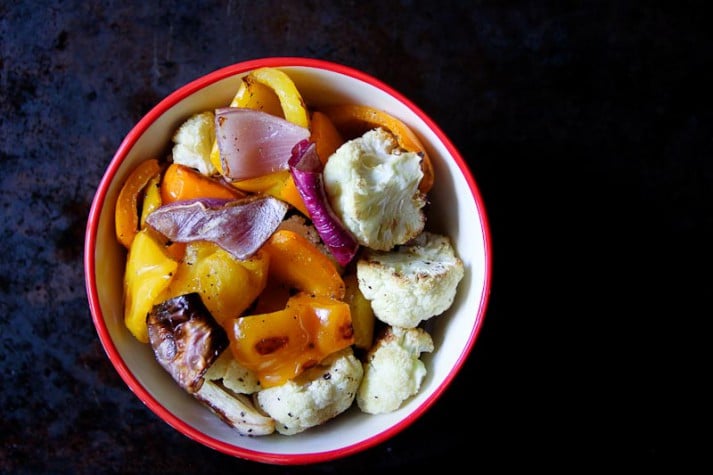
8. Place them in the oven for 30-45 minutes. Check every 15 minutes and stir them up with your spatula so that they get roasted on all sides. This is what they should look like when they’re done. A little crisp and toasty (and brown) on the edges, and they’ve shrunk from releasing water.

Pull them out and pack them up for later in the fridge or serve immediately. You can use roasted veggies as a side or even serve them cold, tossed in with salad to make the flavors a little more interesting.

There you have it: your basic veggie roasting lesson! Roasting vegetables has been a go-to method of cooking for me since I first started cooking for myself, it’s my absolute favorite way to cook and eat plants.
When we’re dedicated to making positive food choices, we can get into a routine of eating the same things for every meal. Steamed spinach, microwaved broccoli, raw carrots… As much as we don’t like to admit it, all that stuff can get boring after a while, and being bored can deplete our willpower bar. Trying a new method of cooking can help! And I promise, if you’ve never roasted vegetables before, if you do it right, you won’t regret it.
Here are some questions and answers you might have about this method of cooking veggies. Don’t worry! I had a lot of questions like these when I first started cooking too. Through some experimentation and a lot of cooking fails, I’ve managed come up with some answers for you. Let’s hope this helps. And if I didn’t cover your question here, feel free to ask it in the comments!
Can you use frozen veggies?
YES! Some folks prefer buying frozen veggies. In many cases, they are cheaper and keep for longer amounts of time. That’s totally cool. Defrost them under some water, pat them dry with a paper towel, and follow steps 4-8!
I don’t like [insert veggie here]. What else can I use?
You can roast almost any vegetable. The only ones I would suggest staying away from are the leafy greens. Those are best steamed, sautéed, or mixed into soups! Here’s a list of some of the veggies that lend themselves well to roasting:
Basic roasted veggies are boring. How do I make it more interesting?
I’m glad you asked. Here are some suggestions:
My veggies turned out mushy and gross! What did I do wrong?
I’ve mentioned the two most common veggie roasting mistakes already in this article, but let’s go over them again in case you missed them.
1) You put too many veggies on the tray at once. If they’re overlapping and piled on top of each other, they’re gonna get soggy. Veggies release a lot of moisture when they’re cooking and if they’re piled on top of each other, they’ll steam instead of roasting and end up mushy.
2) You used a tray with high sides. Instead of a cake pan, try a cookie sheet. It’ll trap less moisture.
So, what other questions or troubles do you have when it comes to roasting veggies?
What are some of your favorite roasted veggie combos?
Are there any other or basic cooking skills would you like to see?
Let’s hear it in the comments!
-Noel
###
Workouts, nutrition guidance, and habit-building. Never wonder where you should put your limited time, energy, and effort.
Get our FREE Starter Kit with dozens of resources today!