Is Barefoot Running Really Better For You?

Screen shot 2009-11-04 at 12.24.17 AM

What if I told you running barefoot was a safer than wearing the latest $200 state-of-the-art, clinically-designed running shoe…is that something you might be interested in?

Sounds ridiculous, right? You’d might even call me crazy, which would then make you crazy by default because you’re yelling at your computer…either way I win.

Now, what if I told you Ethiopian Abebe Bikila ran a world-record 2:15:17 marathon at the 1960 Olympics in Rome…barefoot. Starting to at least see there may be some truth to this madness?  I want to discuss my the pros and cons of ditching your shoes, my experiences with running barefoot, and then teach you HOW to run barefoot if you’re will to give it a shot.

How I ended up barefoot…kinda

I few months ago, I went to the local Nike Store and picked up a pair of expensive running shoes designed to provide the “most support and padding.” As I was walking to the checkout counter, I walked past a pair of Nike Free shoes. They looked interesting, so I asked about them; the lady behind the counter responded: “oh, those are shoes meant to mimic barefoot running, which means you have practically no padding under your feet.  They’re pretty uncomfortable.”  I shrugged my shoulders, then bought my new kicks.

Fast-forward a month: my buddy Saint up in Massachusetts, the one who lost 33 pounds in 12 weeks, tells me about these funky feet-glove things called Vibram Five-Finger shoes (pictured below).  A few quick searches on the internet leads me to stories and stories and stories about how amazing they are.  In fact, Tim Ferriss, life hacker extraordinaire, wrote quite the article on these shoes, explaining they cured his chronic back pain in a matter of weeks.  They looked ridiculous, and they sounded too good to be true – I went out and picked up a pair the next day.

It’s now been two months, and my $100 running shoes are collecting dust in the closet. I wear my Vibrams to the gym every day and on an occasional jog (which I actually ENJOY now).  The first time I went running “barefoot,” my entire running style had somehow changed immediately.  I no longer took long strides and landed on my heels; instead, I took short powerful strides and landed as softly as possible on the balls of my feet.  This wasn’t done intentionally, it’s just kind of how my body adapted to running barefoot.  Considering my form changed instantly, everything suddenly clicked: this is how we are naturally designed to run!

My excitement at this ‘discovery’ was quickly overshadowed by the pain in my calves.  Despite only running for 10 minutes, it was apparently enough to keep my calves sore for many days afterward.  Why?  Thanks to modern running shoes, our feet, Achilles tendons, and calves have essentially atrophied from non-use. Remember the scene in the Matrix where Neo wakes up for the first time in the “real world” and asks Morpheus, “Why do my eyes hurt?” Do you remember Morpheus’s response?

“Because you’ve never used them before.”

Whoa.
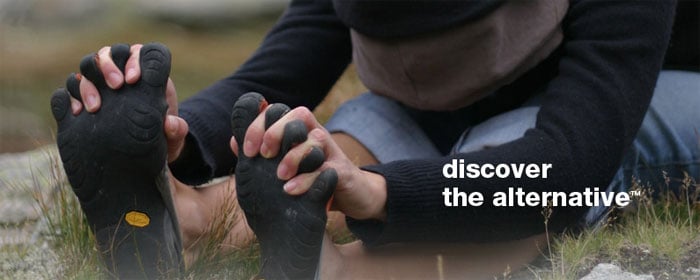
Vibram-Five-Fingers

Barefoot Goes Mainstream

Now, the barefoot running concept has been around for quite a while (thousands and thousands of years to be exact), but thanks to books like Born to Run (which I reviewed here), recent articles in the New York Times, and products like FiveFingers shoes, the concept of barefoot running is coming out of the shadows and back into the spotlight.

According to Chris McDougal, author of Born To Run, injury rates among runners has remained virtually unchanged despite thirty years of technological advancements and hundreds of clinical studies and “improvements.”  Why is it that we can put man on the moon, clone sheep, and create the internet (thanks Al Gore!) but we can’t cut down on running injuries? Why is it that Nike has spent hundreds of millions of dollars developing the world’s most comfortable running shoes, and then suddenly decides to develop a shoe at the other end of the spectrum (the Nike Free) with virtually no padding?  My guess is that they might have discovered that their shoes are possibly doing more harm than good.  Can that be proven though?  That’s what I wanted to know.

Studies on Barefoot Running

Before I went out and purchased my crazy ninja-gorilla shoes, I made sure to do the proper research and make sure they’re the real deal.  I found testimonial after testimonial of people whose chronic injuries disappeared and running times improved since switching to barefoot.  However, I wanted to track down some actual statistics and scientific studies to support all of these stories.

According to This Australian study:

My take: Although I haven’t done extensive long-distance running barefoot myself, I’ve done enough to understand why these conclusions make sense.  Add my experiences with the thousands and thousands of people who have become injury-free since making the switch and I can’t help but believe these barefoot people are onto something.  The author of the study goes on to say that more studies must be completed as the studies that were completed in developing countries had too many variables to be considered 100% factual proof.  However, I will bet my life savings (currently $12.30; $6.30 if I decide to eat lunch today) that more controlled studies from the United States are right around the corner.

I still wanted more proof, so I stumbled across this great marathon article: Daniel Lieberman, a professor of biological anthropology at Harvard University (oooooooh, nerd alert):

When you walk, you land on your heel, but during running you land toward the middle of your foot on your plantar arch.  The arch acts as a spring, stretching and then recoiling, not only helping to cushion the impact of the collision with the ground, but also to help push the body into the air. Laboratory studies show that the plantar arch alone returns at least 17 percent of the energy of impact. Running shoes have largely replaced our arches, but they are neither as effective nor as durable. Barefoot runners can clearly do as well as shod runners, but it takes time to develop the strength in the foot to use our natural arch fully.

Lieberman then goes on to say that “people don’t run barefoot any more simply because they don’t have to,” he said. “The barefoot running movement is wonderful evidence of how good the human foot is for doing one of the most natural and fundamental of all human activities—endurance running.”

Alongside all the anecdotal evidence, these are two pretty strong cases in favor of ditching your shoes. However, there are certainly plenty of reasons why you SHOULDN’T run barefoot.  In the spirit of good discussion, I’m hoping this becomes the greatest debate since Frank the Tank defeated James Carville on the topic of the government’s role in supporting innovation in the field of biotechnology.  On with the negatives!

What’s Wrong With Barefoot Running?

For every person that shouts the benefits of running barefoot, there are 10 people ready to explain why it’s such a ridiculous concept.  If you take a look at the previously stated New York Times article, a majority of the comments at the end of the article come from people who have tried running sans shoes and love it, or they come from people who immediately discredit it despite having never tried it.  Some of those arguments are below:

Argument: Your feet are going to get destroyed – sure we might have adapted to run barefoot through thousands of years of evolution, but our feet haven’t adjusted to modern technology and surfaces like concrete and asphalt. Factor in loose rocks, garbage, dog sh*t, etc. and running barefoot is NOT smart.

Counterargument: Fair point.  However, if you start paying attention to where you are running you won’t have these problems.  If you are concerned with stepping on infectious stuff, try a pair of Vibram Five Finger shoes, which have a thick tough underskin to protect you from debris.  I have been running on asphalt, but I can see how running on concrete could cause problems.

Argument: It’s too damn cold to run barefoot.  My feet will get frosbite.

Counterargument: I completely agree, which makes me sad because I like running barefoot.  I think I’m going to get a pair of low heel running shoes for the winter because I don’t want my toes to freeze.

Argument: “If running barefoot is so great, why aren’t barefoot runners setting records?” The same NYT article cited a race in which none of the runners who mimicked a barefoot style (type of stride and foot-placement) won.  They concluded from this study that this style of running does not make you faster.

Counterargument: I think this article is ridiculous for using this as a source, as it’s not whether or not they win, but if they’re run faster relative to themselves.  Sure the people with the barefoot style might not have won, but they might have finished faster than if they had run with a more conventional style.  The winners of the race might have run even FASTER if they had been training barefoot style, or they could have been slower.  We don’t know.  Essentially, this ’source’ is full of holes and variables and cannot be used to either credit or discredit barefoot running.

Argument: “What about flat footed people? Without special orthopedics your foot will get even more mangled.”

Counterargument: I need to find more studies to support this theory, but if we are to believe Tim Ferriss (and I do trust the man): “[going 'barefoot' in the Vibrams] has been nothing short of spectacular for me, despite my history of flat feet.  I’ve found that my arches, and foot as a whole, feels better with less support rather than more.”

I’m sure there are quite a few more reasons to keep your uber-comfortable Nikes, so please post your arguments in the comments.

Why I Support Barefoot Running

After reading countless studies, dozens and dozens of articles, and speaking with tons of people about their experiences with running barefoot, I decided to throw caution into the wind and take the plunge.  Since making the switch, I have become a full time convert.  Other than the articles stated above, here are my reasons:

How to Run Barefoot

Okay, so hopefully now you’re at least willing to give this crazy concept a shot. First things first: you aren’t just changing your shoes.  You are changing your running STYLE too, which will keep you from getting injured. Rather than try to explain it to you myself, I’ll borrow from the guys who know what they’re doing:

The barefoot running technique has been described as falling forward. It has also been described as gently kissing the ground with the balls of your feet. If you need one more concept to meditate on while running barefoot, imagine that a log is lying across the path in front of you; you don’t want to kick the front of the log with your toes. You want to step over the log with each step, keeping your knee bent and placing the ball of your foot immediately behind the log as your chest moves over the top of it.

Here’s a video from Chris McDougal, author of Born to Run. Watch the video and notice how different his running style probably is from yours:


Born to Run

Chris recently wrote a Men’s Health Article on how to run barefoot – “Imagine your kid is running into the street and you have to sprint after her in bare feet,” he says. That’s the visual: “You’d automatically lock into perfect form — you’d be up on your forefeet, with your back erect, head steady, arms high, elbows driving, and feet touching down quickly on the forefoot and kicking back toward your butt.” And then, to build the strength and balance to maintain that form over long distances, use the heel, hips, and hills principle.

  1. Wear the most neutral, low-heeled running shoe that feels comfortable.
  2. Keep your hips dead under your shoulders and dead above your feet.
  3. Use big hills to iron out the rest of the wrinkles. “You can’t run uphill powerfully with poor bio-mechanics,” Orton says. “Just doesn’t work. If you try landing on your heel with a straight leg, you’ll tip over backward.”

Some Precautions

Don’t forget Neo, you’re opening your eyes for the first time.  Here are some tips for ya:

Yup, that was definitely the longest post I have ever written. If you’re still awake at this point, I’d love to hear your thoughts.  If you’ve tried running barefoot and loved it, tell the world.  If you’ve tried it and hated it, I want to know about it.  Think the studies above are full of crap?  Explain why!

What say you, NF Community?  Barefoot: yay or nay?

-Steve

If you haven’t already done so, download my free E-Book, “A Newbie’s Guide to Fitness” and please sign up for the RSS Feed of Nerd Fitness or get NF posts daily via email.

Additional barefoot resources:

Picture from: Nicholas_T

Exercise, Level Up Your Life

If you enjoyed this post, please consider to leave a comment or subscribe to the feed and get future articles delivered to your feed reader.

  • mschoeffler
    Great post! I've been pretty curious about the Vibrams too.Your article just sold me - I'll be trying these as soon as the snow clears off the streets.
  • podence
    Great, comprehensive overview. I'm just diving in myself and been reaching many of the same conclusions. Living in New England adds a wrinkle this time of year. http://odence.wordpress.com/
  • Thanks for this! I just got my first pair of Vibram KSO's a few days ago to go along with POSE method training. I went on my first run tonight not even thinking that my calves would be more engaged than in a more conventional heel-strike method. All I can say is that I'm sore, and somehow got a blood blister on my big toe (which oddly doesn't hurt).

    The shoes are uber comfortable, and I can't wait to do a triathlon in them.
  • Tim
    Great article. I've been running wearing Chuck's - it was as close as I could get to barefoot running while deployed. I'm about to go home for mid-tour leave, and I have a pair of Vibram's waiting for me. I've had recurrent problems with debilitating shin splints, and the thinner shoes seem to be helping.
  • Thanks for this extremely timely article. I have been researching bare foot running for the past week or so and this nicely summarizes the information out there. I have always wanted to add more running to my routine but it always ends up not working out due to pain etc. Even though running more on the balls of the my feet in normal shoes did help some just not enough. I can't wait to try some out hopefully next week.
  • Interesting post. I have horrific flat feet and have always done the traditional arch support style of management. In fact I find that if I wear something that has no support anywhere like some Crocs or sandles that my feet get sore and hurt very fast.

    I'd probably give it a try, but $100 is a bit much to experiment with at this point. Being deep down south, there's not much good outdoor running weather either so I'm pretty much stuck to treadmills if I want a run. How do these hold up on a treadmill? I can't imagine running barefoot on a treadmill is very safe, but who knows.
  • I use mine on the treadmill almost everyday. They do warm up a bit on the bottom especially if your treadmill has a higher HP motor. I notice too that when I run (because of friction duh!) they get warmer faster. But I walk for 45 minutes or an hour and I haven't caught on fire yet.
  • Great post about barefoot running. Steve, how are Vibrams on a wet surface? And is there any warmth to them?
  • NerdFitness
    Hey Porter, I haven't done a lot of running in them when it's raining, but I believe they were initially designed for sailors who wanted to get more grip on the decks of their ships, so I'd hypothesize that they hold up well.

    As far as warmth, it depends on the kind you get. I hear the new ones (http://www.vibramfivefingers.com/products/produ...) have thicker and softer insides which would keep you warmer. They also look like they have much stronger treads on them, which could help in wetter weather.

    Maybe one of the other readers can chime in?

    -NF Steve
  • I have the Treks (accidentally called them 'trails' in my post above). Unfortunately I can't compare them to the other models since they're my first pair. I've been running a trail with a very steep section, and even after the recent rains when the trail was muddy I had no traction issues - I can actually feel them gripping on the uphill sections.

    The leather is really thin though, so I don't imagine they'll be much warmer or more waterproof than any of the other models.
  • JFreedom
    With the KSO's, running on wet grass or light standing water on pavement hasn't posed much of a problem. If you're doing sprints, there's a good chance you'll slip a little now and then (less traction and surface area on the balls of your feet). Otherwise, it feels more efficient to use them when it's wet when cause there's not much water absorption to weigh you down.
  • I've had occasion to wear mine (Classics) in the wet, and they hold up relatively well despite getting soggy. I've never had any slip in them, and overall, I would compare the warmth to a sock.
  • HenryJ
    I live in the Puget Sound area in Washington State and have been using Vibram KSOs for my everyday shoes since July (I'm not really a runner). The numb toes factor isn't as big of an issue as one might think, at least for me. Because my toes and other parts of my feet are actually being used now, the Vibrams have really changed the way the blood circulates in my feet. I walk to work some days (a mile each way) through puddles and some gnarly winds, and my feet aren't noticeably colder. They certainly don't get numb. Of course it's still only November, so we'll see how they feel in January. Vibram also has a model called Flow, which has a 1.2mm layer of neoprene thermal insulation. I may have to order a pair of those by then, but for now the KSO's are working fine for autumn in the pacific northwest.
  • tsledge
    Here's what my old Cross Country coach told me about running barefoot: "If you've been running/walking barefoot since you were a kid, you'll be fine. No problem. However, if you've been wearing shoes all your life, you're only going to injure your feet.

    This of course was before the time of Vibrams. I'll be sticking to Mizunos.
  • That same argument could be made for running itself - 'if you haven't been running since you were a kid, you're only going to injure yourself'. Both statements are true, but they leave out the important part - 'unless you take the time to properly condition yourself to it'. Switching to barefoot running is no different than when you first start running - you have to take it slow and avoid the temptation to push too hard until your body adapts.

    I just made the same mistake I've made in the past when starting up running (with traditional shoes before) - as my calves/feet started to adapt to the new shoes I got overconfident and pushed too hard and fast on a run, and ended up with shin splints. Doesn't matter what kind of shoes you're wearing - overuse is overuse and will result in the same injuries. Fortunately for me shin splints are an easy reminder to take it easy, a few days rest and I'm back at it again.
  • tsledge
    Your statement "if you haven't been running since you were a kid, you're only going to injure yourself" is just plain wrong. Perfect example: back in high school during the summer our Cross Country team attends a Sequoia running camp. One year a friend of the coaches, Jim came. Jim is in his 40s. He'd never trained as a running in high school or college. He was easily keeping up with the fastest high school runners (we're fast). Needless to say, he hadn't been running since he was a kid, yet contrary to your argument he was running well and wasn't injured.

    Also, shinsplints aren't the result of "push[ing] too hard and fast on a run." They are the are the result of an imbalance between your calf and shin muscles with your calf being stronger. The easy fix is to pace back and forth ten steps each on your heels. This strengthens the shin muscle. You can continue your training regime.
  • That's my point exactly - there are many people who've never run before, try it, and get injured. There's also some who don't. My statement is no more or less accurate than your coach's statement about barefoot running. In either case, with proper conditioning injuries can be avoided.

    I'll take your word on the shin splints - it's just my own experience that I inevitably get them when I get overconfident and push myself too far.
  • Yay for sure. I love my Vibrams. Best investment I made ever. This article was what won me over when I was researching: http://www.fourhourworkweek.com/blog/2009/05/07... I realized I was standing very much like the C woman all the time. It was no wonder I had back pain. Now, when I'm not wearing Vibrams, I'm wearing flat flip-flops or ballet flats.
  • JFreedom
    I've been going for runs in the Vibrams for about 2 months off and on, in between my ultimate training and other workouts, and it's the most fun I've had running, ever. I really feel attuned with the ground when running; each step feels unique and takes the boring part out of the running for me. The furthest I've gone in them so far is a bit over 3 miles, and I haven't had any troubles so far. It's been an enjoyable experience, even when it's wet outside.

    Thinkin' about doing the Strong Legs 5K in em, too :)
  • Great post, Steve. Based on my experience, I'd echo Tim Ferriss' comments about flat-footedness. I'm a relatively flat footed person and a decently heavy pronator, and I've found that less support has actually strengthened the muscles in my feet. The caveat here is that I walked around barefoot and started running in my Vibrams doing very light jogs for a while before I started going for a real run in them. Even now, I'm only doing 1-2 miles as I find myself still building some strength. I think the key for readers if that you have to find a comfortable pace and that it is far better to take it slow with this new way of running than jump in head first without doing your research. Thankfully you've provided a slew of it above so we can each make our own decisions about how to proceed.
  • Sonny
    There is a great article in the London Daily mail about barefoot running.
    http://www.dailymail.co.uk/home/moslive/article...
  • NerdFitness
    Great find sonny, looks like more and more people are jumping on the barefoot bandwagon. Hopefully it cuts back on running injuries and gets more people active!

    -NF Steve
  • Dan
    Great post. I've been a supporter of barefoot running since I messed up my knee from "normal" running. Made it impossible for me to run for over a year while the doctors decided what to do with it before I eventually had to have knee surgery (at 23!).

    I'd be a little careful of the Nike Frees though. They do still have a raised heel which prevents you from tucking your feet back under you quickly without landing on your heel (e.g. the problem with standard shoes).

    This is from an interview from the author of Born to Run:

    "Q. What about shoes that claim to simulate barefoot running, like the Nike Free?
    A. Well, I wrote a story about the Nike Free, and I interviewed Barefoot Ted, who said they're nothing like barefooting. They're squishy on the foot, and they have an arch support and a padded heel.
    [note: Barefoot Ted is one of the ultra runners in the book. He runs either barefoot or in the Vibrams. In fact, he is the first runner to be sponsored by Vibram.]"
    http://www.popsci.com/entertainment-amp-gaming/...

    If your looking for alternatives to FFs try having a look here: http://www.posetech.com/runningshoes/archives.html
  • Spencer
    I switched up to a pair of Nike Free 5.0 v4's as my main running shoes about 5 months ago and I love them, I'll never go back to traditional runners. No more shin splints, no more knee pain, and I now look forward to my running days (rather than dreading them).

    The appearance of the 5.0 is a little deceiving, from the side of the shoe it appears that the heel is elevated (like a traditional running shoe), however once you put them on you realize that you stand almost completely flat and there is no appreciable arch support. Keep in mind that the 5.0 is supposed to be a transitional shoe for those who have been running in traditional shoes for years and don't want to dive head-first into barefoot-style running. My next pair is going to be the Free 3.0 which is more flexible than the 5.0, has a completely flat sole, and next to no cushioning.

    How do the Vibram's soles handle sharp rocks? I go trail running every weekend and I'm looking for a new pair of shoes for it, and the KSO's are on my list.
  • Check out the new KSO trails - that's what I've got and when running on trails I can feel the rocks but no pain (so far). They have a slightly thicker & grippier sole than the standard KSO - unfortunately they're more expensive also. But they are made out of kangaroo, so you can jump much higher than in normal shoes...
  • NerdFitness
    Hey Dan,

    Thanks for the comment man, and great call on the being weary on the Nike Frees. I've updated my article with your link...and Barefood Ted cracks me up.

    I didn't know he was sponsored by Vibram, but that is freaking awesome.

    -Steve
blog comments powered by Disqus