
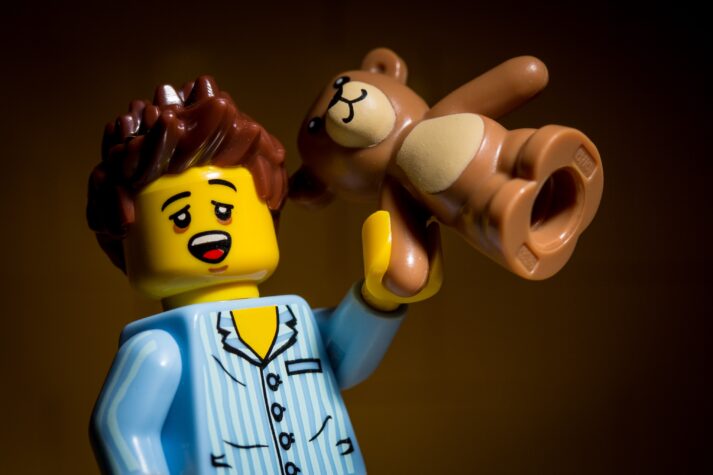
As the legend goes…
If you’re trying to lose weight, don’t eat right before bed.
The thought is that your metabolism slows down at night to prepare for sleep.
Which means if you snack before bedtime, the food resides in your stomach all night long, and unless you’re a sleepwalker, you won’t burn off your meal and your food turns to fat.

That’s why conventional wisdom advises against eating late at night.
It’s summed up in the quote, “Eat breakfast like a king, lunch like a prince, and dinner like a pauper.”
Is all this true?
Is ANY of it true?
Great questions. Should people attempting to lose weight limit their late-night eating, and is there science or studies to back this up? After all, we love science here at NF.
Today, we are tackling these questions:
- What effect does eating late at night have on our bodies?
- Should you eat an early dinner for weight loss?
- Is a big breakfast the answer?
- Where does intermittent fasting fit into all this?
Let’s begin.
SHOULD YOU EAT LATE AT NIGHT?
To answer our question on whether a late night meal is going to stick to your gut, it’ll be helpful to explore where this advice originates.
It comes down to our circadian rhythm, which tells our bodies what time of day it is. If everything is functioning properly, during the day you will feel alert. At night, when it’s time to wind down and sleep, you’ll start to feel tired.
Think of it as an internal clock that helps prioritize bodily functions. Waking, eating, sleeping, etc.
So what’s this got to do with late night chow?
The argument goes that having food past a certain hour goes against our biological clock. Eating outside of our circadian rhythm means our metabolism might not be in proper working order. Which could lead to fat gain. That’s the gist of the argument against late night eating.
And there might be some evidence it’s true.
Experiments in mice support the hypothesis that eating late at night causes fat gain.[1] If you’re picturing a group of mice arguing over what kind of food to get delivered at midnight, I’m right there with you.[2]
One group ate during normal waking hours. The other, at night, against their normal circadian clock. Everything else remained constant, including their exercise and activity.

And all things being equal, the late night eating mice gained more weight.
These are interesting observations, but do they tell the whole story? Is all of our knowledge around late night eating dependent on experimentation with mice?
There are some studies on humans that do show a correlation between late night eating and weight gain.[3] And again, those eating late at night tend to gain more weight than those who don’t.[4]
However, if you’re reading Nerd Fitness, you’re smart. And you know that correlation doesn’t prove causation.
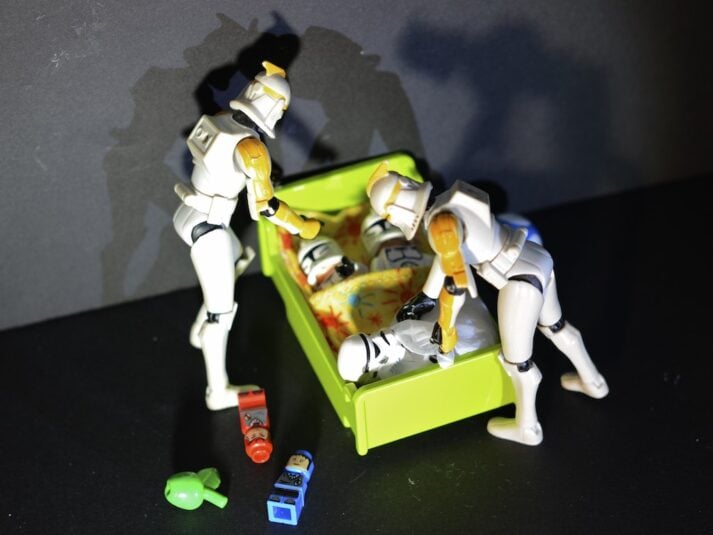
There may be a correlation between wearing a stormtrooper uniform and death, but it doesn’t mean the uniform CAUSES death.
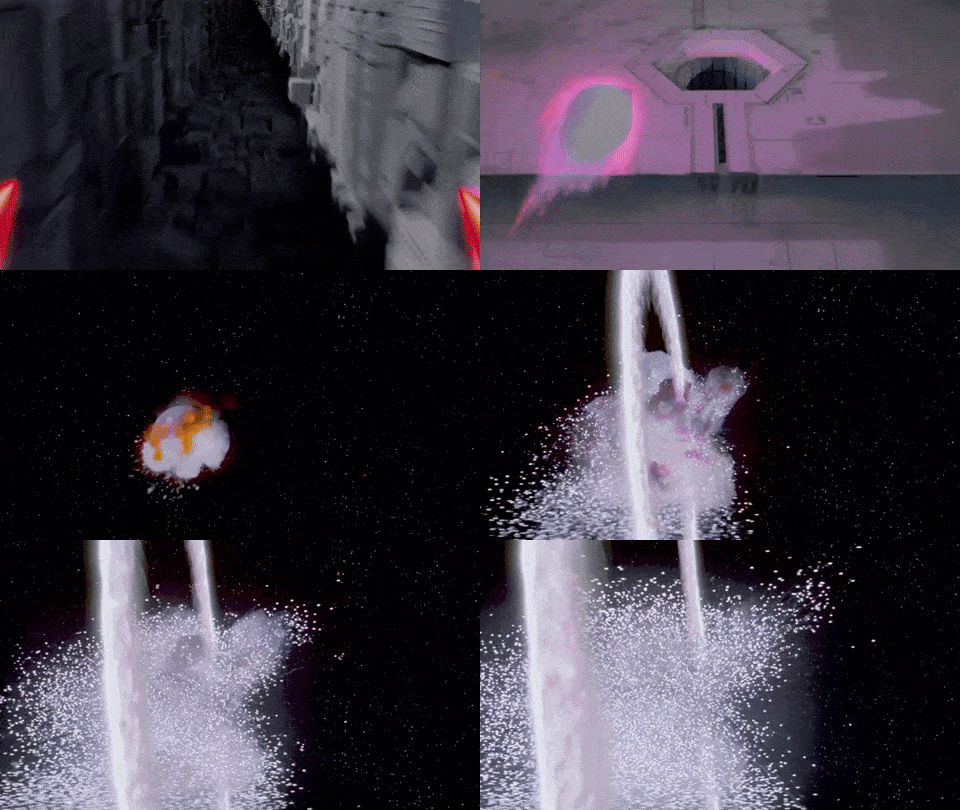
That would be a major defect, like creating an exhaust port that leads straight to your base’s biggest weakness. Oh wait.
Outside of correlation, is there anything physiologically different about eating calories at night versus the day?
DOES LATE NIGHT EATING CAUSE WEIGHT GAIN?
First things first. Let’s talk about your metabolism slowing down at night.
That’s generally what the advice on skipping late night meals rests on. If you eat late, when your metabolism is naturally slowing down (recall the circadian rhythm?), the food is more likely to be stored as fat instead of being burned off.
Yeah, that’s not true.[5]
Your body expends plenty of energy when you sleep!
For example, the process of REM (Rapid Eye Movement) burns quite a bit of energy because our brains are very active during this stage. This is also the stage of sleep where you dream the most. So when you are dreaming of battling a dragon or showing up to school naked, you’re burning calories. Not as much as literally battling a dragon or showing up to school naked, but enough to keep your metabolism engaged.
Also, our bodies do a lot of repair work on our cells, tissue, and muscles at night. All of which requires calories.
Plus, your body needs to do normal things too like breathing, pumping blood, keeping all of your organs functioning, and stealing the blankets from your partner.
When you factor all of this in, your metabolism only slows down about 15% during the night.[6]
And even THEN, with this ‘gasp,’ 15% slowdown, it’s not enough to make you more likely to gain fat by eating later at night compared to during the day. So say the researchers at Oregon State University.[7] Granted, researchers at OSU did their studies on monkeys, but their conclusion matches other research on the subject.[8]
Now, to keep things in perspective and put us back on track.
If you look hard enough, you’ll find studies that show eating late at night actually INCREASES your overnight metabolism.[9] After all – your body needs to burn calories to process the calories you just consumed, right?
That TOO makes sense!
So if our metabolism is still running when we sleep, and calories don’t have a greater impact at night, what’s with the correlation between late night eating and weight gain in humans?
Why do people that eat at night tend to gain more weight compared to people that don’t?
MORE IMPORTANT THAN WHEN YOU EAT, IS HOW MUCH YOU EAT

So what’s causing late-night eaters to gain more weight, if it’s not a slow metabolism?
It’s actually a simple answer: eating anything between dinner and bedtime is considered an extra meal.
More meals equals more food, which equals more calories. Which could lead to more weight gain.
That’s right. People who are eating late at night are eating that meal in addition to all of their other meals. They are overeating, and thus, their body is putting on weight. The timing of the meal is irrelevant, it’s total calories consumed!
To reiterate: it’s not some physiological response to food past a certain hour that will cause weight gain. It’s just that those who eat late at night are probably eating more than those who don’t.[10]
If a late night snack helps you eat smaller meals throughout the day, great!
However, more often than not these late night snacks are just extra calories on top of the meals already eaten. Something we do mindlessly with no real intention. And this can be a recipe for disaster.
This is the real concern of late night eating: extra calories consumed. Not that our body’s metabolism slows down to hibernation levels at night. It’s that we are likely not planning on these extra calories at night.
And that’s not all.
There’s also the topic of food choices to consider. The reality is there aren’t as many healthy meal options late at night versus when the sun is out. People who eat late at night might have to depend on delivery like pizza. Or Taco Bell might be the only thing open at 3am. So it might not be the hour, but the food itself that is the concern.
These are foods that are nutritionally deficient, calorically dense, and very easy to mindlessly over consume in mass quantities.
Plus, lots of late night snacks that people eat are likely junk food. As bariatric physician Dr. Caroline Cederquist says, “At midnight, people will rarely make chicken and salad. They will eat ice cream or chips, the high-fat or high-sugar foods that our bodies store so effectively as fat.”[11] This point argues the central problem of late night eating lies with these high-calorie foods, which are easy to overeat, and don’t contain a lot of nutrition. If you eat these types of snacks consistently, weight gain could be the outcome, no matter the time of day you eat them.
This may very well explain the correlation between late night eating and fat gain. Which matches our philosophy here at Nerd Fitness, “You Can’t Outrun Your Fork” (Scope out Rule #4). It also correlates to America’s love of snacks, and America’s obesity problem: I cover this in our article on snacking.
So if you are going to eat late at night, stick to REAL food whenever possible.
Meats, vegetables, fresh fruit, etc. Stay away from processed junk food, which seems to be the real danger of eating before bed. Eating an apple with some almond butter before bed is a lot different than cookies. If you want help adjusting your snacks to REAL food, check out our Beginner’s Guide to Healthy Eating. That article will walk you through how to create habits on eating real, natural, nutritious food. Foods you can eat any time of day.
But let’s also be realists here, because I love junk food too. If you want to eat ice cream or have a cookie before bed, go for it! Just PLAN ahead by eating smaller portioned meals earlier in the day, and make up for it the next day by eating a significantly smaller breakfast.
If all this talk on the timing of meals and eating REAL food stresses you out, and you want to be told exactly what to do, we can help!
Our uber-popular 1-on-1 coaching program pairs you with your own Nerd Fitness Coach who will get to know YOU, your goals, and your lifestyle, and develops a plan that’s specific to not only your body, but also to your schedule and life. We take the guesswork and uncertainty out of the timing of meals and overall diet, to help busy people just like you level up their lives.
Wanna see if we are a good fit for each other? Click on the big box below to schedule a free call! We’d love to talk with you, no matter what.

SHOULD YOU TIME YOUR MEALS?
I want to make one more point. After saying everything I said above, there could be some benefit to planning and restricting the time you eat during the day.
I’m a big fan of scheduled eating times and scheduled fasting times – this is a generally referred to as intermittent fasting.
It’s not a diet per se, but a diet pattern.
I personally only eat calories in an eight-hour window each a day. For example, if I start eating at noon, I’ll eat my last calorie by 8pm. This means no late night snacks for me. This time-restricted eating strategy works as a great way to limit overall caloric intake.
Here’s why: although I eat bigger meals for lunch and dinner, skipping breakfast results in the net effect of “Steve eats less overall.” No snacks, no multiple small meals throughout the day. Just two big meals to fuel my needs.
If you’re looking to lose weight, intermittent fasting could be a strategy for calorie control that works for you. Specifically, if you can’t help but eat late at night for whatever reason, then cutting out breakfast and making lunch the first meal of the day could mitigate a lot of the additional calories you consume later. Now, intermittent fasting isn’t for everybody, and it affects men and women differently, so be sure to read our Beginner’s Guide to Intermittent Fasting to get the full details. We cover the ins and outs of intermittent fasting, and how to create a practice that works for your situation.
Many NF readers have experienced success with intermittent fasting. After all, it’s one less meal to worry about. You can use the extra time to focus on what your two healthy meals should be, instead of worrying about a bunch of small meals and snacks throughout the day.
If you want to learn more about IF, and download a worksheet to help you get going, you can grab our Beginner’s Guide to Intermittent Fasting FREE when you sign-up in the box below:
CONCERNS OF LATE NIGHT EATING

I couldn’t end this article without mentioning two possible concerns on late night eating, outside of extra calories and food quality.
I want to talk about how late night eating might disrupt sleep itself.
If you’re staying up late at night to eat, you might be doing this at the expense of going to bed earlier, which could lead to sleep issues. As we cover in our article on sleep, when you’re sleep deprived and tired, your body tends to crave more food. More calories to fuel your exhausted body. And if you’re already staying up later to eat more food, you’re creating a vicious cycle.
Crapola.
As pointed out by science and thermodynamics, losing weight is about burning more calories than you consume. Being exhausted and needing more calories to get through the day makes this much more difficult.
So if you’re eating late at night, make sure that you’re still getting plenty of good shuteye. Don’t stay up all night mindlessly snacking. A well-rested nerd is a happy and healthy nerd.
Also, one last thing: there is some evidence that a late night meal might disrupt the quality of your sleep. [12] This might come back to our circadian rhythm, as a late night meal does seem to have an impact on delaying the stage of REM sleep.
This might be the real danger of late night eating.
Not that the calories will stick to your stomach, but that eating late at night might disrupt the sleepy time you are about to embark on by shifting your body’s priorities to digestion, thus throwing off your circadian rhythm as you prepare for sleep.
So forgo late night eating?
My advice: experiment on yourself. No not like that.
With your food and the timing of your food consumption.
A lot of these studies are at the early stages, and more research needs to be done to reach concrete conclusions on the health impact of the timing of our meals. So:
- If a meal before bed helps you skip breakfast the next morning so you can rock your day, do it!
- If you notice a late night meal makes you toss and turn at night, try eating a little bit earlier.
I always encourage self-experimentation, and that holds true for the timing of meals. If your life sucks without breakfast, EAT BREAKFAST. If you do better with a good, healthy snack before bed, EAT YOUR LATE NIGHT SNACK.
For me personally, I know that eating too much food directly before hitting the hay leads to a night of tossing and turning without any awesome dreams of me with a jetpack flying around the world.
But, to each their own.
You’re an adult (I assume).
So don’t get so caught up in studies that you ignore what your own body is telling you. Do what works for you – and if eating late at night is causing you to gain weight, cut back on the calories and see if that changes things.
One last important point:
If you can’t help yourself from eating sweets and snacks late at night, then plan for it! Eat smaller dinners and breakfasts, or have one less snack throughout the day. We don’t plan for perfection. We plan for Murphy’s law – anything that can go wrong will go wrong.
And just hoping you stop eating late night food isn’t a strategy. So instead, plan for the worst and set yourself up to succeed even when you succumb to the late night cravings!
That about does it for this article. It’s up to you to decide if late night eating works for you or should be avoided. Either way, the next time you hear someone tell you to eat dinner like a pauper, maybe take it with a grain of salt. Nod politely, and then get back to doing what’s best for you.
Now I want to hear from you!
Do you eat late at night or do you restrict your eating window?
Does a late night snack help you prepare for the next day?
Or does it disrupt your sleep?
Let me know in the comments.
Sweet (or unsweet) dreams!
Steve,
PS: ONE FINAL TIP: if you’re going to eat ice cream late at night, don’t eat it right out of the carton with a spoon. Get a scoop, put it in a bowl, and go sit down. You’ll eat half as much, and hate yourself half as much the next day.
PPS: I’ll wrap up this article by again mentioning our 1-on-1 Online Coaching Program. If you’re worried about losing weight, and not sure if your late night meals are helping or hurting, we can help! We’ll get to know you, your situation, and your goals, to come up with a plan! Schedule a call with our team to see if it’s a good fit for you!
###
All photo sources can be found in this footnote right here. [13]