
I bet you weighed yourself this morning.
Did you like the number you saw, or were you expecting something lower?
Did you get overly excited if it was low or unreasonably depressed if it was too high?
We’ve all been there, so don’t beat yourself up too much.
Seriously, quit hitting yourself!

Whenever somebody tells me that he or she is going to get in shape, it’s always something like: “I’m going to lose 50 pounds,” or “If I can just get down to 200, I’ll be good.”
I’m here to tell you that you should reconsider stepping on that scale anytime soon.
Why?
Because although picking an arbitrary number for weight loss is a decent starting point (and it’s definitely good to set goals), your scale certainly doesn’t tell the whole story and can send you on an unnecessary roller coaster of emotions.
Yes I do realize most roller coasters are amazing – the emotional ones kind of suck though.
Today we explain why the scale is only one piece of the puzzle.
A quick note before we jump in: I bet you’re reading this because you’re struggling to get the scale to move in the direction you want. Believe it or not, 90% of the equation is your diet!
I know how tough it can be to stick with a nutritional plan, and that most people abandon a diet after a few weeks! Plus, dieting stinks. We took this into account and created a 10-Level system that allows you to slowly change your diet to get in shape the right way, and change your physique permanently. Pick a level, follow the instructions, level up when you’re ready. Done!
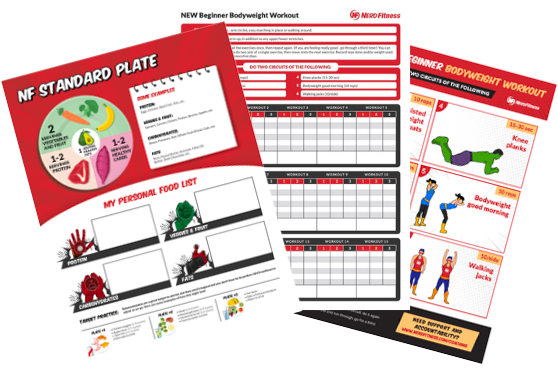
Grab our free NF Diet strategy guide when you sign up in the box below, and then keep reading this article about why scales suck!
- Follow our 10-level nutrition system at your own pace
- What you need to know about weight loss and healthy eating
- 3 Simple rules we follow every day to stay on target
1) Your weight will fluctuate more than the stock market
The human body is one incredibly complex piece of machinery. There are things going in, coming out, transforming, and dissolving all of the time. As a result, your weight can fluctuate wildly over the course of a 24-48 hour period, by up to five to six pounds.[1]
Let’s chat about some variables that can change by the hour:
What did you eat or drink today? All food and water have weight to them. An eight-ounce glass of water will add weight to you, because it itself has some weight (half a pound). Even eating a salad will affect your weight, since vegetables are heavier than air.
How much sodium did you have today? Consuming salt will make you retain water.[2] The more water you are holding, the more you will weigh.
Did you eat any carbs today? Speaking of water weight, eating carbohydrates can make you hold onto water.[3] Refined carbohydrates in particular, like bread and pasta, cause a high insulin response. When insulin is high, you hold onto more sodium, meaning more water.[4] Which is why people often lose a lot of water weight when following a low-carb or ketogenic diet.
Additionally, carbohydrates are stored in your muscles as glycogen. What’s attached with the glycogen? More water.
What time of the month is it? Following along on our trend of water weight, a menstrual cycle will also cause water retention, meaning more overall weight.
Have you, ah, been hitting up the bathroom today? I’ll just say it: urine and feces weigh something. You do the math.
When did you work out last? Exercising will cause you to sweat, which means less water. But you’ll also likely drink more water in response, which will have an impact on the scale too.
If you’re trying to lose weight the healthy way (a pound a week is a good goal to shoot for), your successful weight loss could be hidden by any number of circumstances that falsify your statistics.
That means you could be down three pounds since last week, but because you ate Chinese food last night (oh hey sodium), drank water this morning, and didn’t get to weigh yourself til the afternoon (while wearing jeans), the scale could show a GAIN of one pound. After working so hard, this “weight gain” can instantly demoralize you, sending you to the kitchen for some pity rocky-road ice cream and then over to the couch for a Game of Thrones marathon.
It’s just a number, and it can vary widely over a short period of time.
2) Your weight does NOT tell the whole story
The scale alone often won’t demonstrate fitness progress.
I have two pictures from my past to as an example, taken about four years apart.
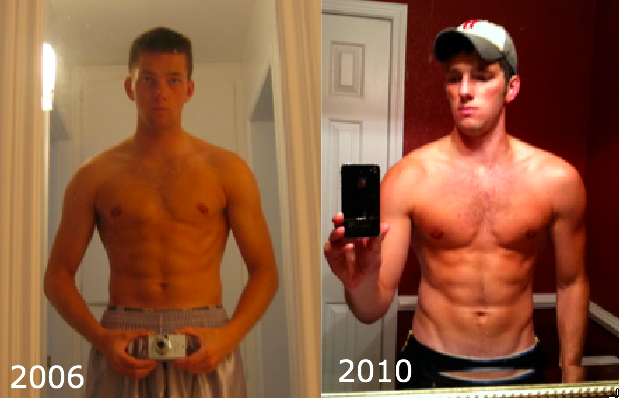
Want to know something crazy? I weighed the EXACT SAME AMOUNT in both pictures.
While my body weight in the two photos may be identical, it’s clear to see I packed on more muscle for the photo on the right.
What’s going on?
Let’s discuss a couple changes the scale might not be capturing:
Yes, it’s true that muscle weighs more than fat. Although if you want to be technical about it, a pound of muscle weighs the same as a pound of fat. That’s what “pounds” mean. However, a pound of fat takes up about twice the space as a pound of muscle, since muscle is about twice as dense as fat. That’s why people typically lean out as they drop their body fat percentage.
Strength training will increase bone density. On average, bones make up about 15% of body weight. And strength training will increase bone density, meaning they’ll weigh more.[5] After some time strength training, your bones might literally drive the scale up.
That’s why – although I weighed the same – I likely had more muscle, denser bones, and less body fat over the four year period.
All good things in my book.[6]
3) The scale does not define you
If you set out to lose 100 pounds in a year – an incredibly ambitious goal – and you only manage to lose 85, you might consider yourself a failure. After all, you set a goal and failed to achieve it, right?
YOU STILL LOST 85 freaking pounds, something you might have been struggling to do for years. I bet you’ve had to buy a whole new wardrobe and get all kinds of “holy crap you’ve lost a lot of weight!” comments.
Not bad for a failure, huh?
Don’t get caught up in the numbers game, and instead be proud of what you have accomplished instead.

I had a friend who wanted to get down to 199 pounds badly. He went from 235 pounds down to 202 pounds, and got stuck there for weeks. I remember trying to get him out of his funk: he saw himself as a failure for not losing those three pounds, when in reality he had lost 30+ pounds, completely redesigned his body and his diet, and was in better shape than he had been in years.
You’re not a statistic.
You’re not a number.
If you’re reading this, it means you’re part of the Rebellion.
I want you to know that if you’re like my friend, frustrated by missing your goal, you’re not alone.
We constantly receive emails from Rebels, letting us know they are struggling to hit their fitness goals. It’s actually the reason we decided to create our 1-on-1 Online Coaching Program, so we could offer specific guidance tailored to their individual needs.
Here’s how it works: we get to learn your goals, lifestyle, challenges, and situation: Kids? An old injury? A job that requires travel? All the above? We got you covered.
We’ll then pair you with a coach from Team Nerd Fitness that fits your personality and situation. They’ll work with you to build custom workouts and nutrition guidance to meet any goal you might have. Unless that goal is ruthless world domination. Use your powers for good, okay?
Want to see if we are a good fit for each other? Click on the button below to schedule a free call. We’d love to talk to you, no matter what!

How to keep track of your success instead

I will admit that the scale can have its uses. If you’re just getting started, a few big changes in the first few weeks can really help you see progress and build momentum.
Also, over long periods of time, it’s a good way to tell if you’re headed in the right direction or not.
However, a scale can also cause all kinds of mental issues that bring you down quickly, and becomes less and less important as you get closer to your goals.
Here’s how you can stay strong and motivated without stepping on a scale regularly:
Remember that your journey to a healthier life is a marathon, not a sprint. Changes from day to day are practically meaningless and incredibly difficult to quantify, so go with changes over a longer period of time. Weigh yourself once a month or every other week to make sure you’re trending in the right direction. If it’s weekly, make sure you weigh yourself at the same time of the day, wearing the same type of clothing. Remove as many of the variables as possible to make your reading accurate. And even then, don’t put too much stock into it.
Look at your body composition rather than your weight. I try to take a picture of myself every month or so, giving me the chance to compare how I look. You can also buy a body fat caliper (I use this one) or tape measure to keep track how your body is adjusting. Just make sure you’re taking your measurements in the same places on your body at the same time of day. If you’re taking photos, take a straight-on photo and a profile photo.
Set goals that are not weight-oriented. Say you want to do 15 push-ups, run a half marathon, and/or do a pull-up. With your mind focused on a strength building or endurance goal, you won’t have to worry so much about a dumb scale. If you can only do 5 push ups now but next month you can do 15, you definitely got stronger, but you probably also lost some fat.
Keep a journal. I know plenty of 170-pound people who are out of shape and 250-pound folks who are incredibly healthy. How do you FEEL this month compared to last month? Maybe you can now run around the track without stopping, you don’t get winded going up and down stairs, and you can give your kids a piggy back ride without being out of commission for days afterward. Keep track of your energy levels, your conditioning, and your overall well-being. Screw the scale.
If you’re interested in other ways to track your fitness progress, I’d encourage you to check out our post “How to Properly Track Your Progress.” We cover the tips above, plus much more.
As the saying goes, “You have to track the problem to crack the problem.” Make sure you look into ways of tracking besides a single scale.
What say you?

Are you a scale junkie?
I’m a recovering one. However, over the years I’ve learned my overall health, strength, and happiness are far better indicators of how I’m doing.
Moral of the story – if the scale is working for you and you’re seeing results, stick with it. If that number on the scale constantly screws with your mind, maybe it’s time to take a break.
So how about you?
Have you had success with stepping a scale daily? Had some rough weeks because of what the scale said? How about skipping the scale entirely and seeing great results?
Let’s hear some scale-related stories from the Rebellion!
-Steve
PS: Ready to change your physique the right way? Want to have an actual plan to follow? Grab our NF Diet Strategy Guide and our Strength Training 101: Everything You Need to Know free when you join the Rebellion and sign up in the box below:
- Follow our 10-level nutrition system at your own pace
- What you need to know about weight loss and healthy eating
- 3 Simple rules we follow every day to stay on target
###
All photo sources can be found right here.[7]