Download Our Free Tools
Workouts, nutrition guidance, and habit-building. Never wonder where you should put your limited time, energy, and effort.
Get our FREE Starter Kit with dozens of resources today!


You’re here because you want the truth on sugar.
Perhaps you have questions like:
Is eating sugar dangerous?
Are all sugars REALLY more or less the same?
What about artificial sweeteners?
Well my friend, I’ve got answers! And memes.
Many of our coaching clients come to us confused about sugar, so we decided to set the record straight in today’s guide.
Here’s what we’ll cover to answer the question, “Is eating sugar bad for you?”

What we call “sugar” is actually a group of molecules that share a similar structure.
You can think of them as “sugars,” plural, since there’s a bunch of them. If it ends in “ose,” like “fructose,” it’s gonna be a sugar.
This means sugar is not just the white cubes we throw into our coffee.

Here are some sugars you may come across:
We could go on and on…
Just about every food you eat will have some sugar in it, even if it’s just trace amounts (meat will have glycogen in it, which is composed of glucose). Most food even contains multiple forms of sugar.
Check out this banana, taken from Precision Nutrition’s excellent article on sugar:
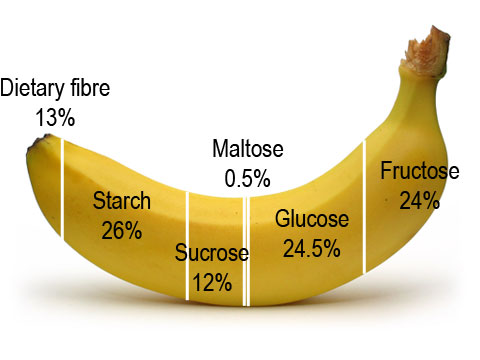
Yep, lot’s of different sugars in there.
You also see “dietary fibre” and “starch” listed above, which aren’t sugars, but are part of the carbohydrate family.[1]
All sugars are carbohydrates, but not all carbohydrates are sugars.
Most carbohydrates, like starch, are broken into simple sugars during digestion. Although some of them, like fiber, are not.
You’ll often hear this concept referred to as “Net Carbs,” and you can check out our full Guide on the Keto Diet for more.
At this point, you may be thinking, “Steve, it looks like sugar is in everything. Why does everyone say it’s bad for you?”

You’re reading this article because you want to know if eating sugar is terrible for you.
I understand your concern, because the mantra “sugar will kill you” is so pervasive in our culture it’s almost taken as a given.[2]
Like a lot of things in life, including Rubix cubes, the answer to this is complex.
We’ll let science and studies guide us (as always), but we should introduce a caveat for the rest of this section: human beings are diverse and varied:
We truly are unique snowflakes.

Now that we got that disclaimer out of the way, let’s get right to it.
#1) Does sugar cause fat gain?
We probably all know somebody (or maybe ourselves) who eat lots of sugary products and are overweight.
The number one question we get as part of our coaching program, outside of “What’s Steve’s favorite video game?” is “Does eating sugar make me fat?”[3]
It’s a valid question, one with a theory behind it: the consumption of carbs (and sugars) are the main drivers of insulin release. One of the functions of insulin is to help us store fat.
So if we do the math here, eating carbs and sugars releases insulin, which then makes us fat, right?
The question then is: are people eating too many calories in sugar form and becoming overweight?
Or is their insulin response to sugar/carbs causing them to store extra calories and become overweight?
So, what’s the science say?
Luckily, we have the exact answer to that question:
In 2015, Dr. Kevin Hall conducted a study where he was able to control EVERY variable and actually get to the truth behind carb consumption and weight gain.
His participants were stationed in a metabolic ward, so Hall practically achieved 100% dietary compliance in his patients: every movement, every calorie consumed, every bodily function, every breath exhaled was tracked.
The setting allowed Hall to tinker with carb and fat levels, precisely, to find out if either macronutrient had more of an impact on fat loss.

The results?
It doesn’t really matter whether subjects went low-carb or low-fat.[4]
Studies suggest that lower-fat diets seem to perform about the same as lower-carb diets with regards to weight management.[5]
So what gives? It turned out it’s TOTAL CALORIES CONSUMED and burned for weight management.
Low-fat or low-carb, doesn’t matter for weight loss, with all other variables tracked.
In a more extreme example, a doctor was able to lose weight while eating Twinkies and other junk food (not recommended). This is not to say an all-sugar diet is healthy, but rather one’s weight management is really dependent on calories of any source.
In other words: as long as you burn more calories than you consume, even if those calories come from sugar-filled processed food, you can lose weight.
You might not feel great, and it’s probably not healthy in the long run……

But you can lose weight eating sugar, as long as you plan properly for how many calories you consume.
Speaking of which, you can determine how many calories you should eat every day using our handy Total Daily Energy Expenditure Calculator!
The main point I’m trying to make: You might function well on a higher carb or lower carb plan. But please don’t give up fresh fruit (just because of the sugar), start eating 4000 calories of coconut oil, and then wonder why you gained weight.
It comes down to energy balance, my friend!
#2) Does sugar cause diabetes?
Outside of fat gain, another main concern of eating sugars rests on blood sugar management.
With type II diabetes, patients have a hard time regulating blood sugar with insulin. So the thought is to restrict sugar, the main driver of insulin.
Again, what does the science say?
NOW, there does seem to be a link between the increased consumption of sugar and the risk of diabetes, though as we know there’s plenty of nuance here. Sugar itself might not be the culprit, but simply the extra calories we’re consuming coming from sugar:
What this means: even if you eat added sugar, you can minimize the risk by keeping your weight in control and getting some exercise.

Here’s the big problem with sugar:
It just gives us calories but doesn’t necessarily fill us up.
This is the real problem with sugar consumption!
The risk of diabetes (and even heart disease) can be influenced a lot by weight management.[8]
So, overall weight management comes down to managing calories consumed regularly.
And sugar has lots of calories (4 calories per gram of sugar).
This means minimizing sugar intake CAN give us the best fighting chance to consume fewer calories without feeling miserable.
Case in point: Here’s 200 calories worth of Coca-Cola (all from sugar):[9]

That’s 17.5 oz, less than what you’d find in a 20 oz bottle of Coke (yes I did the math myself. 20 > 17.5).
Let’s compare that to 200 calories from some kiwi:

One of these is a beverage you’ll consume WHILE eating food, and the other is actual food that can fill you up and make you feel satiated and full.
The big point I’m trying to tattoo to your forehead:
Calories count. And when we consume sugary foods that don’t fill us up, we’re more likely to overeat.
So we’re better off getting our calories from ACTUAL sources of food if we’re trying to lose weight.
This could be a good time to dive into food that naturally contains lots of sugar: fruit.
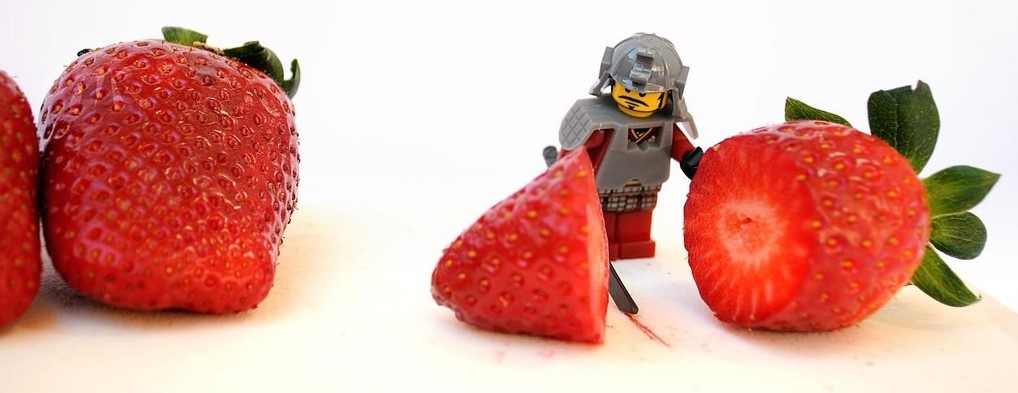
Fruit has the sugar (fructose) contained in its cell walls, so it’s literally covered in nutrients.
This means we can ignore the “empty calories” concern from earlier.
Plus, fruits are loaded with fiber and water, so it’s not strictly composed of fructose.
Thus, the Nerd Fitness stance on fruit:
You can read our article “Is Fruit Healthy?” for a complete investigation.
So eating fruit is fine.

How about fruit juice?
Eh, less so! Although no foods should be off limits, fruit juice isn’t much different than drinking soda: it’s just a high calorie beverage. If you enjoy the taste, drink it! But just remember that our bodies obey the laws of thermodynamics and all calories count!
At this point, I can anticipate your next question:

Sugar may not directly contribute to fat gain or other illnesses, but it’s still probably a good idea to manage your intake for all the reasons listed above.
Again, there are no nutrients, so your daily allotment of calories is probably better spent on REAL FOOD that fills you up and makes you feel good.
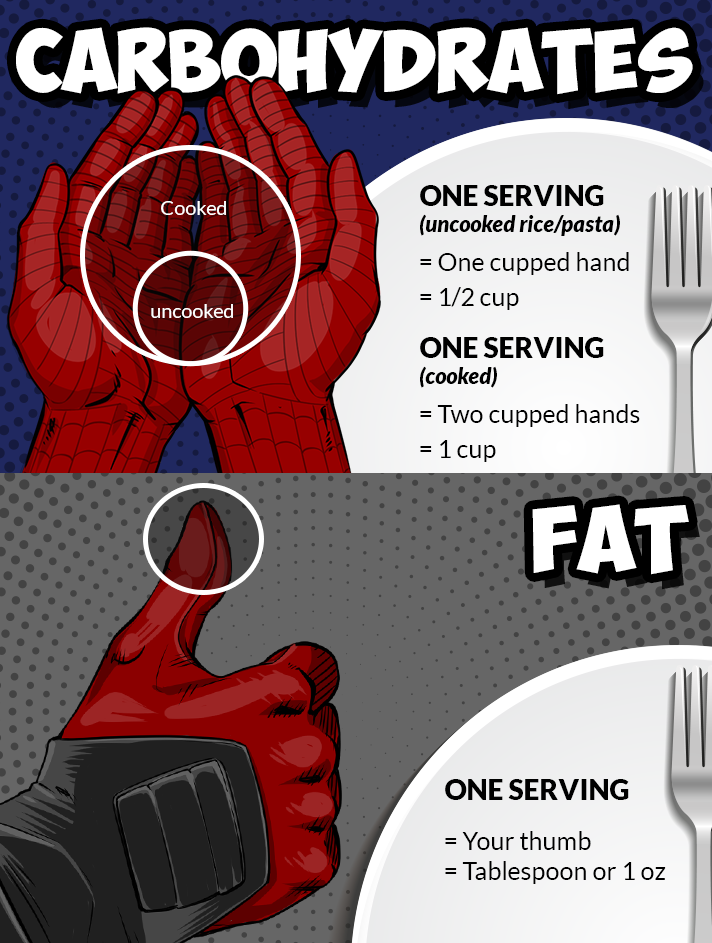
We have an entire Guide on Healthy Eating that breaks it all down, and also includes sweet graphics like this to help you learn portion sizes:
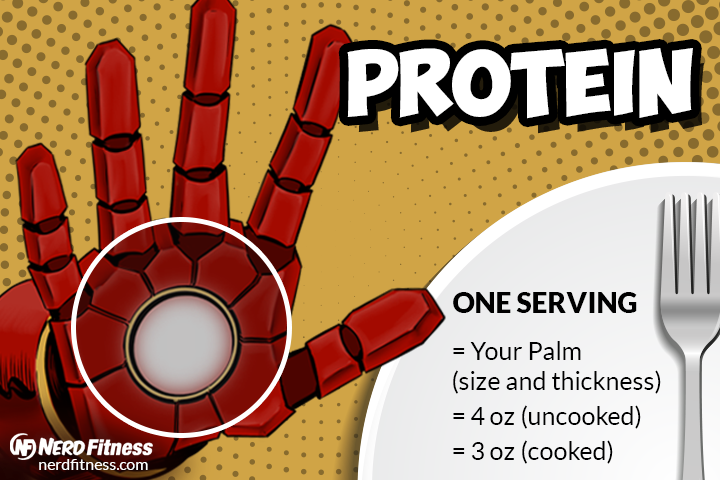
Don’t get too lost in the details. You read Nerd Fitness. You’re smart. You know what real food is:
By avoiding tons of sugar, you allow yourself to fill up on nutrient-dense foods that also happen to be low in calories.
“Steve, this is all well and good, but I want specifics! Exactly how much sugar can I have a day!?! I want cake!”
I hear ya, consuming sugar can be one of life’s great joys.

Again, we are all different, so our ability to handle and process sugar is varied. However, the 2015-2020 Dietary Guidelines for Americans states that sugar should only make up 10% of your daily calories.
That means if you follow a 2,000 calorie diet, 200 calories can come from sugar (or 50 grams).
For reference, there are 39 grams of sugar in a can of coke. This would be an argument for drinking Diet Coke.
How many calories do you need per day to meet your fitness goals? I’ve got a couple resources for you to check out.

“Sugar addiction” is a term that’s thrown around a lot lately.
Is it legit?
Can people be addicted to sugar?

Eh…
The evidence for addiction to strict sugar is weak.[10] It just doesn’t fit the list of classifications required to qualify as a genuine addiction.
Here’s what’s probably actually going on: people crave “hyperpalatable food,” which often includes sugar.
Think of it this way:
It’s the combination of sugar, fat, and salt, that gets people “hooked.”[11]
It’s not strictly the sugar in food, but the combination of sugar with other stuff.
If you find yourself feeling cravings for hyperpalatable foods, I want you to know you’re not alone. One of the top concerns that comes up in our 1-on-1 Online Coaching Program is “food cravings.”
This makes sense. These foods were designed to do precisely this: hijack your brain’s reward system.
Nothing in nature resembles a chocolate chip cookie.
For some of us, when we come in contact with it, the lizard part of our brain kicks in and screams, “EAT FAT, EAT SUGAR, EAT SALT. NOW!”

Here are some tips on how to manage “food cravings”:
If you need someone to share the frustrations of your food cravings with, know that we are here for you. We discuss proper nutrition with each one of our coaching clients, even if they don’t have any relationship issues with food. Although many of them do.

Sugar might not be the worst thing for you.
But how about “fake sugar” or artificial sweeteners?
We explore this question thoroughly in our article “Is Diet Soda Bad for You?” but I’ll give you a summary now, because I like you.
When it comes to low-calorie sugar replacements:
In my opinion, if you’re after weight loss and choosing between the low-calorie Diet Coke or the sugar-filled regular Coca-Cola, go with diet.

Let’s recap this article for you and create a plan for where to go from here.
First up, that recap.
When it comes to sugar, we need to remember:
Where do you go from here?
If you think you might be consuming too much sugar, based on what we’ve discussed today, try to scale it back ever so slightly:
We’ve seen time and time again here at Nerd Fitness that small changes are the true keys to success.

It’s where I’d recommend you start.
Need some help from here? An exact plan to follow? Alright, you got it, but only because you’ve been nice this whole time.
#1) Our 1-on-1 Online Coaching Program: a coaching program for busy people to help them make better food choices, stay accountable, and get healthier, permanently.
You can schedule a free call with our team so we can get to know you and see if our coaching program is right for you. Just click on the image below for more details:
#2) The Nerd Fitness Academy – This self-paced online course has helped 50,000 people get results permanently.
There’s a 10-level nutrition system, boss battles, 20+ workouts, and the most supportive community in the galaxy!
#3) Join The Rebellion! We have a free email newsletter that we send out twice per week, full of tips and tricks to help you get healthy, get strong, and have fun doing so.
I’ll also send you tons of free guides that you can use to start leveling up your life too:
Alright, I think that about does it for this article.
Now, your turn:
What are your thoughts on sugar?
Do you have a strategy around your sugar intake?
Think I’ve got it all totally wrong?
Let me know in the comments!
-Steve
PS: If you’re just starting your nutrition journey, make sure you check out our Guide on Healthy Eating. We discuss how sugar fits into a proper diet, macronutrient ratios, and portions sizes (using sweet graphs like this):
###
GIF source: coffee sugar, snowflake, Groundhog Day, Men in Black, Ren and Stimpy,
Photo source: Indiana Jones and the Sugar Crocodiles, This Cleanup Is Going To Take A While, sugar, Rainbow Cake, sugar ants, sunset, Diet Coke, Fruit Ninja
Workouts, nutrition guidance, and habit-building. Never wonder where you should put your limited time, energy, and effort.
Get our FREE Starter Kit with dozens of resources today!