Download Our Free Tools
Workouts, nutrition guidance, and habit-building. Never wonder where you should put your limited time, energy, and effort.
Get our FREE Starter Kit with dozens of resources today!


The past 7 months have been really eye-opening for me.
In May of 2018, after spending the past 33 years of my life trying to get bigger…

I decided to go in the other direction:
I was going to make a concerted effort to get as lean as possible while still having a life.
After 6 weeks of very focused effort (counting calories) and seeing NO progress, I made a few key adjustments.
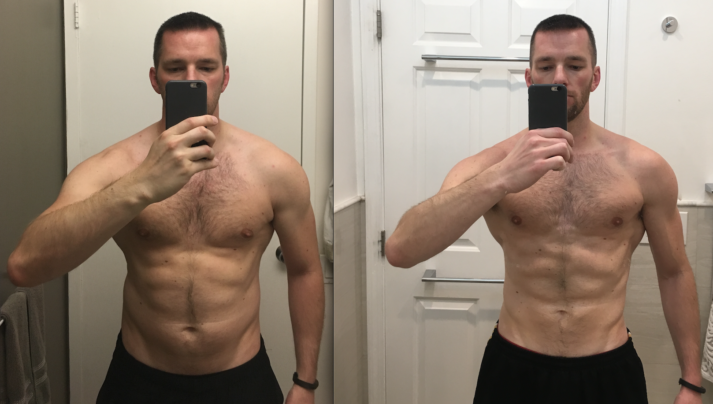
Since then, I’ve lost 22 pounds AND hit strength training personal bests:
Sure, we’ve featured success stories from people in our community who have lost 100+ pounds in a year, 50+ pounds in a year, and other amazing transformations.
So, who wants to hear about an in-shape guy who got more in shape?
BORING!
However, I want to share my story for a few reasons.
For starters, I want to show that 15+ years later, I still practice what I preach and I’m still learning every day.
Next, I want to share the things I did that might seem counterintuitive:
Whether you have those final stubborn 10-15 pounds to lose, or you have 80+ pounds to lose, I promise the lessons I share here can help you level up.
Note: We all have our challenges, and we all find certain things easy and other things brutally difficult.
As you read, you’re NOT allowed to say the following:
And instead, you’re ONLY allowed to say:
“How can I make this lesson work for me in my situation?”
Also: this is just ONE way to lose weight. I know some people will operate better on a lower fat diet (like I did), while some will find it easier to lose weight following a low-carb diet.
You do you, boo.
Here are the 7 biggest lessons I learned while losing 22 pounds and leveling up my workouts…

If you are trying to lose weight, calorie restriction is King (or Queen).
In order to lose weight consistently, my body needed to be in a “caloric deficit”: burning more calories than I ate, consistently.
Most people attempt to do this by out-exercising a bad diet.
I don’t have time to run marathons every day, so I instead put 95% of my effort into fine-tuning my nutrition.
Specifically, I knew I needed to be in a slight caloric deficit each week.
Within that week though, there was quite a bit of variety.
I ate more calories on training days (to help rebuild muscle), and fewer calories on non-training days (to force my body to pull from fat stores).
However, the average between the two was low enough to force my body to start burning stored fat which led to overall weight loss.
As a 6 foot tall, 190 pound male who trains 4x a week, here’s how I ate to get down to 168 pounds:
I followed the above calorie strategy with a 90%+ compliance rate. I share in #8 below the exact foods I ate, and when.
In other words, I did not let perfect be the enemy of the good. (Calculate your own caloric intake estimates here.)
I knew one bad day wouldn’t screw up any progress – it’s total calories consumed over many weeks and months, so as long as my average day was good, I would get results.
I’ll get into what those calories were composed of and how I trained below. But my strategy allowed me to build strength and minimize muscle loss despite the deficit (yes, you can lose weight and build muscle at the same time).
LESSON: Start with calories – know how many you eat daily, and adjust the number down. You can vary your calorie count for training days or rest days – as long as your total average number is low enough to induce weight loss.
Tracking calories and not getting results?
You’re still not broken! Check your tracking – see #4.

I strength trained 4 days per week for about 60 minutes each workout without fail.
This is something I truly prioritized in my life. I can count on 1 hand the number of times I did not hit the gym 4 days in a week.
Each day composed of a heavy barbell lift:
I also did lots of body weight training and gymnastic ring work:
So, despite the fact that I was losing weight and eating a caloric deficit consistently, judging by the pictures and my measurements I was able to maintain most of my muscle, and even build strength strategically.
For example, I hit a personal best deadlift of 420 pounds – a 30 pound record, at a weight of 172 pounds.
View this post on Instagram
By lifting VERY HEAVY weights while also eating a caloric deficit, my body was forced to adapt.
It diverted as many resources as possible to “rebuild muscle stronger to prepare for the next weight training session,” which didn’t leave many calories for “store as fat.”
I cover this extensively in both “Why can’t I lose weight?” and “Can you build muscle and burn fat at the same time?”
Not only that, but because I was in a deficit my body started pulling from the “store as fat” pile to fuel myself and my workouts.
So this strategy really crushed it for me:
LESSON: Most people go about weight loss by creating a calorie deficit and doing a bunch of cardio – this means their body will burn both fat and muscle for extra energy. Weight can be lost from both places.
If your goal is to build a muscular, lean physique, you need to teach your body to preserve as much muscle as possible – and you do that by training heavy!

For the past 6 months, I’ve been batch cooking up a storm.
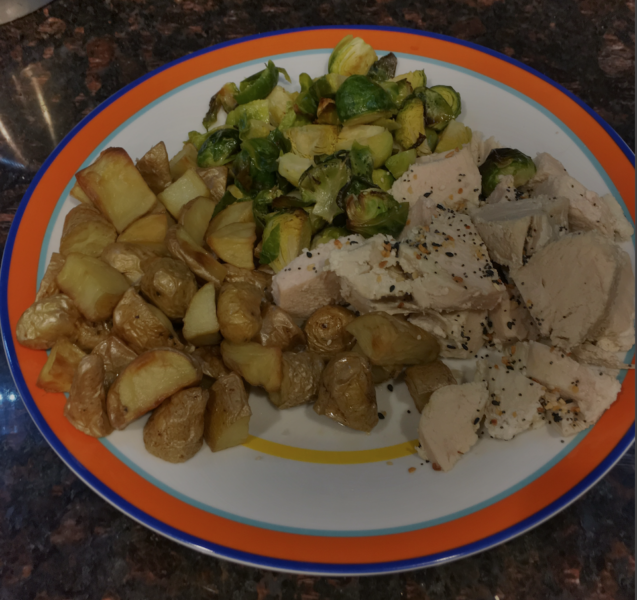
1-2 times per week, I batch cook trays of chicken breast, potatoes, Brussels sprouts, broccoli, and/or cauliflower.
Most days, my dinner looks like this:
And most weeks, my fridge looks like this:
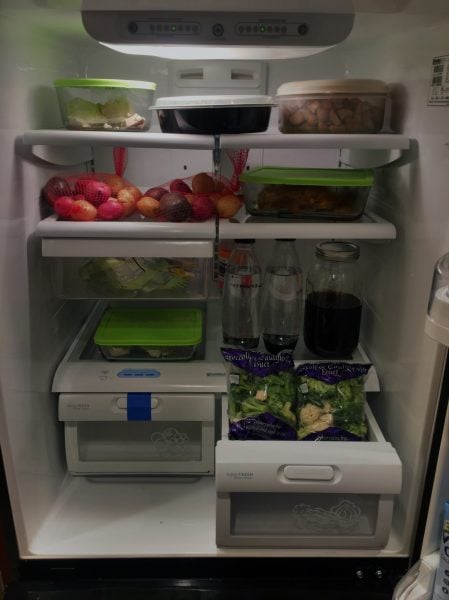
To answer your next question: That’s SodaStream sparkling water (much cheaper than buying bottles or cans), and homemade cold brew coffee. Yes, I’m a weirdo who drinks cold brew in the dead of winter!
By batch cooking just once a week, aka making ONE big effort just once, it essentially changed my default behavior for the rest of the week and set me up to succeed.
I had developed this nasty habit of ordering delivery multiple nights per week – which practically everybody does in Manhattan.
Here’s why: compared to cooking a whole meal, it was just easier to a hit button on my phone and have food show up 30 minutes later.
However, once I started batch cooking, the “lazy” option WAS the healthy (and far less expensive) option.
Every evening, I could either:
Here’s what I batch cooked:
Once a week or so, I’d go out to dinner with friends or family and eat whatever the hell I wanted. I’d also drink whiskey (neat). I went on multiple trips and vacations during these past 7 months, but I was always proactive with my planning.
I knew the more diligent I was with my weekly behavior, the more ‘fun’ I could have with my ‘occasional’ behavior and still not get derailed.
The most important part: by eating the same foods each day, I knew exact portion sizes without having to calculate or figure out much. I just did the same stuff over and over.
LESSON: Your default behavior is the reason you are where you are right now with your health. So change your default. Consider batch cooking to make the easy, lazy, default option the healthiest.
Learn to cook one thing. Literally one thing. And then expand from there once you build up some confidence!

For the first 6 weeks of my weight loss journey, the scale didn’t budge.
I couldn’t figure out what the heck was going wrong.
If you’ve ever tried to lose weight and the scale didn’t go down, it’s easy to assume, “my metabolism is broken” or “it’s because I’m eating carbs” or “my body is unique and different. Damn my parent’s genetics.”
I was counting calories accurately (or so I thought), and the scale didn’t move which made my head hurt.
Clearly I was broken, right?
All those years of ‘bulking’ had ruined my body and I was no longer able to lose weight.
Welp, as a firm believer in things like “science” and “logic,” I decided to test my assumption that I was actually eating the amount of food I thought I was eating.
So I bought a cheap ass $10 food scale.
And it rocked my world.

EYE OPENING EXAMPLE: I eat 3 servings of oats each day, blended into my post workout and post dinner smoothies. A serving of oats is described as “½ cup or 40 grams.” So I used ½ cup of a measuring cup and thought that was pretty close to accurate.
I then WEIGHED half a cup of oats, and it came out to 60 grams!
Which means that for 6 weeks, I consumed an extra 225 calories without realizing it.
The same thing happened with my lunch from Chipotle: I weighed out the portion of rice in the serving, and compared it against the weight that Chipotle says is a serving. Again, I was overeating by 50%.
Realizing that I was overeating my carb portions by 50% multiple times per day, NO WONDER I wasn’t losing weight.
I was accidentally overeating hundreds of calories every day without even realizing it.
So I adjusted my food intake accordingly.
And for the next 5-6 months, my weight steadily declined.
Part of me was frustrated, embarrassed, and angry that I didn’t realize I was overeating with every meal of every day.
The other part of me is SO THANKFUL I was tracking everything and dug deeper when I wasn’t getting the results that I should have.
For starters, I stepped on the scale every morning at the same time of day.
I kept a rolling 7-day average to make sure the trend was moving in the right direction, but didn’t sweat variations from day to day. After all, water weight, sodium, one unhealthy meal – can really make the day swing.
I’m very thankful I educated myself on the exact macronutrient breakdown of the foods I ate regularly.
I also took weekly pictures from the front and side. Week to week I couldn’t see changes.
But month to month, especially with the scale moving down, I started to see differences and was encouraged with the progress.
Plus, I got new bath towels.
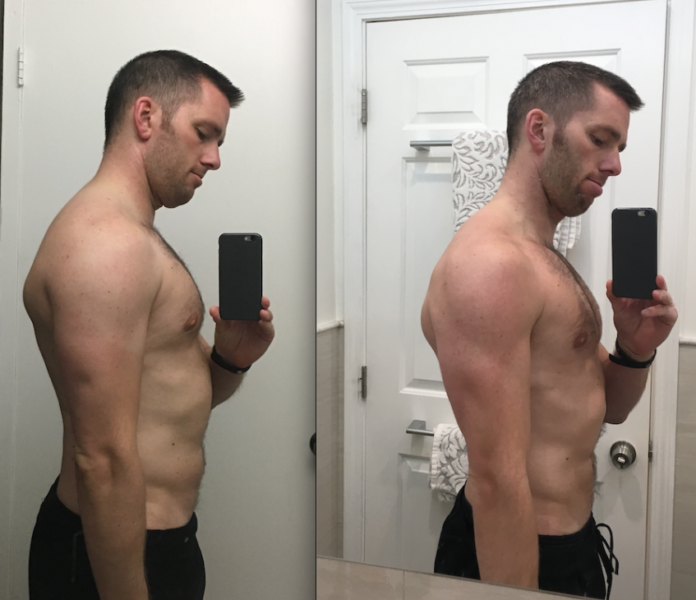
LESSON: Educate yourself on the food you’re eating, and how much. Every online calorie calculator will give you a different answer, so they should be considered just a STARTING point.
Learning these things can help you start to craft the experiment you’re conducting of “If I eat like this, I will lose weight/build muscle.”
And then start tracking your progress!
And then make small adjustments based on the results you’re seeing. Adjust your calorie intake down or up.
Not getting the results you’re expecting? Consider tracking your food more closely to educate yourself even further!
ONE FINAL NOTE: When in doubt, eat less. Studies show we are terrible at counting, estimating, and remembering. So you’re probably overeating without realizing it.
If your goal is weight loss, err on the side of “less” and you’ll probably consume the correct amount.
Want to know my favorite ab exercises that allowed me to get a 6 pack (with those final 2 abs poking through?)
I actually didn’t do any “cardio” or ab exercises over the past 7 months.
Another note: I didn’t do any bootcamps or “muscle confusion” or any of that stuff either.
And yet here I am with 8-pack abs, healthy and happy, despite not focusing my efforts on my stomach.
What gives? Why didn’t I do those things?
Because I hate ab exercises, I hate bootcamps, and I hate cardio.
You also can’t spot reduce fat. A flat stomach comes from a low body fat percentage.
Sure, I went for walks, often long ones through the city.
Sometimes through the course of a day I would walk 5+ miles.
But I never went for a run, or got on a treadmill, or used an elliptical.
Instead, I just focused on getting stronger, eating a caloric deficit, consuming enough protein, and getting enough sleep.
I trained my body to think: “I better build muscle, because I know I’m gonna need it again soon.” My body then diverted as many resources to muscle building as possible, pulling from fat stores for energy, and helped me lean out while staying strong.
Abs aren’t made in the gym, as they say – they’re made in the kitchen.
Everybody has ab muscles, they’re just hidden under layers of fat.
So to get my abs to ‘pop’ it simply required me to cut my body fat percentage low enough to remove the fat on top of them.
Again, I didn’t focus any effort on my stomach because I knew that part would take care of itself if I got my strength training and calories correct.
LESSON: Cardio can help, but isn’t a prerequisite for weight loss. To build a certain type of physique, you need to eat and train in a certain way.

These days, it’s easy to assume carbs are evil.
Paleo says “booo” to carbs, while Keto says “GTFO” to nearly all carbs.
So what’s the real deal?
Is the choice REALLY:
Nope. Thermodynamics still apply. I do 100% agree that certain people are affected differently by delicious combinations of carbs and sugar and fat (check out The End of Overeating for a deep dive into this).
At the same time, vilifying carbs doesn’t get to the root of the problem, or set you up to live a sustainably healthy, happy life.
Carbs can still be a valuable part of a nutritional strategy, provided they’re used strategically!
I ate rice, oats, and potatoes most days:
Notice anything missing from my list of ‘approved foods above?’
Liquid carbs.
I didn’t drink any sugary beverages – I stuck to black coffee, tea, or water. I occasionally drank alcohol, but that was 1 or 2 drinks, once a week or so.
Notice anything else missing? Snacks.
I ate my big lunch and shake. And a big dinner and shake. But no snacks between meals. No grazing. Because I wasn’t sabotaging my efforts between meals with calories, I could eat BIG meals – with carbs – and still come in under my caloric deficit each day.
This is much easier when you’re eating nutritious food that fills you up!
So how do carbs fit into a weight loss plan?
Carbs help replenish the glycogen stores in my muscles (which get depleted during a workout), provide me with fuel, and help me not be miserable while staying in a caloric deficit most days.
They’re also delicious.
The reason carb heavy foods get a bad rap is because most people don’t know true serving sizes.
They’re easy to overeat, and people can’t stop themselves once they start. This is why these foods are notorious for causing people to gain weight.
I still eat plenty of carbs in potato or rice form, I just make sure I have the correct amount, and make sure the rest of my plate is filled with protein and veggies.
There’s nothing inherently wrong with carbs – you just have a smaller margin for error if you plan on eating them while trying to lose weight!
If you accidentally eat 2 servings of broccoli, you might consume an extra 30-50 calories. Accidentally overeat candy, soda, pasta, or cake? It could be hundreds of calories.
So – yes, you can eat carbs. You just need to plan for them. And know that you have a smaller margin for error if your goal is weight loss – especially as you get down to lower body fat percentages.
LESSON: Don’t eliminate carbs completely if doing so will cause to go off the rails and give up on your miserable diet.
Continue to eat them, just eat them intelligently!
For example, a portion of pasta is probably 30% of the size of what image you currently have in your head.
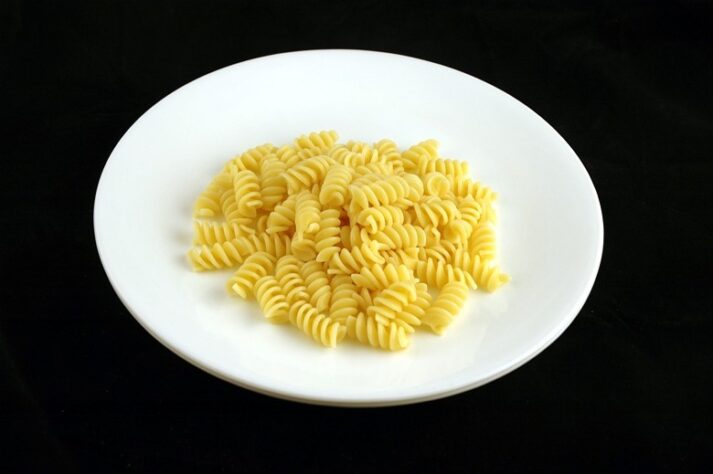
Some other tips:

I have an online coach.
I could say it’s expensive, but that’s relative.
He’s worth every penny.
Either something is worth it, or it isn’t.
We all pay $12/month for Netflix and $60 a month for a phone and $80 a month for internet because it’s worth it to us.
I personally pay hundreds of dollars a month for an online coach because the return on investment I get for my health, my confidence, and outsourcing my workout programming is a no-brainer for me.
Here’s why:
I simply followed my coach’s instructions.
I know that I never would have been able to lose this weight or hit my deadlifting goals without him: easily picking up 420 pounds at 172 pounds of bodyweight.
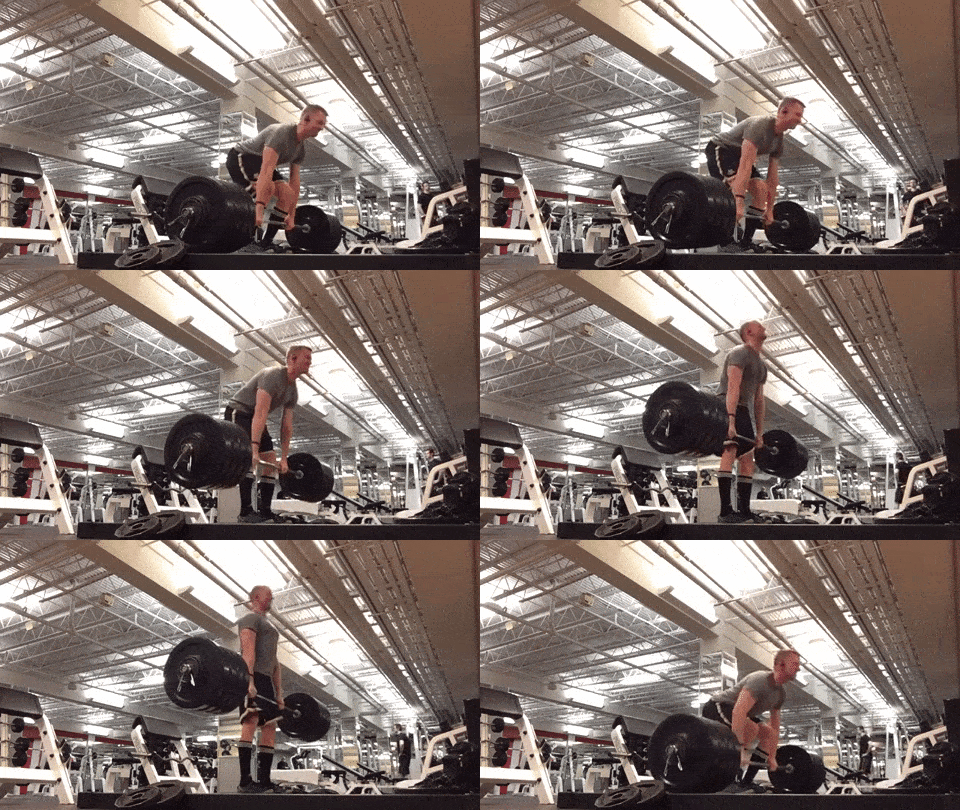
I can’t wait to see what I’m capable of next, and I hope my coach (Shout out Anthony!) will work with me for the next decade!
500 pound deadlift? I think so.
LESSON: Every day, whether you realize it or not, you prioritize what you invest in with your time and your money. I used to invest my time and money in ordering takeout, travel, and nights out at the bar.
I minimized a lot of those things to instead focus my investment in two key areas:
How are you investing your time and money? It’s not what you say, it’s what you do that shows your true priorities.
If you are serious about your health, if you have specific goals you want to reach, or you’ve tried multiple times to get in shape on your own without success, consider hiring a coach.
It’s a serious investment, but I’ve found it to be the best money I spend each month. I had so much success with it, and we had so many people requesting Nerd Fitness instruction, that we built our own coaching program.
You can learn more about our Coaching Program and speak with our team by signing up in the box below:


Everybody asks, so I figure I’ll just tell you the exact portions. You’ll notice that I ate a LOT of protein.
Because I was eating a caloric deficit, my goal was to eat plenty of protein, which helped me feel full (not hungry), give my muscles enough fuel to rebuild themselves, AND not lose my strength.
Training days: 2,600 calories
Non-training days: 2,115 cal
TRAINING DAYS:
REST DAYS:
SPECIFIC SUPPLEMENTS:
Any other questions? Leave them in the comments below and I can expand this section!

My weight loss and strength gains weren’t effortless, but they also don’t feel unsustainable.
My largest investment each month is my coach, and he’s worth every penny.
Otherwise, my days are fairly boring and consistent:
Sure, I don’t look like an Instagram fitness model, and Marvel Studios won’t be calling anytime soon.
That’s okay with me!
This is what 7 months of focused effort, calorie counting, and consistent strength training results look like for somebody trying to get lean.
I also enjoyed myself. Outside of running Nerd Fitness, I probably read 30 books in those 7 months, enjoyed the occasional adult beverage and slice of pizza, spent plenty of time playing video games (I just finished the story of Red Dead Redemption 2), and still took vacations and trips to visit friends and family.
I was also damn focused and really dedicated to my efforts over these past 7 months.
They say “happiness equals reality minus expectations.”
We’re sold quick fixes by beautiful people, and assume in just 7 minutes a day, or with a pill or powder, we too can look like them.
This is my reality: a nerd who lives and breathes this stuff, trying to build a better physique sustainably, while also enjoying life.
Make sure you have the right expectations matched with what you’re willing to sacrifice!
Here’s what it required:
I know I know, this isn’t very sexy.
Measuring stuff isn’t effortless. And saying no is hard. But damn it, I am so proud of the past 7 months and can’t wait to see what the next 7 months hold.
THE MOST IMPORTANT PART: This feels sustainable to me.
I didn’t crash diet. I didn’t put myself through misery and manipulate water intake to look “ripped” for my “after” photo.
It’s more like a “before and now” instead of “before and after,” because this is me as I am.
I feel like I can eat like this for the next 10 years. I can make small adjustments to build more muscle while staying lean, and start working towards hitting a 500 lb deadlift.
To recap:
I hope this helps you make your next steps.
If you have 100+ pounds to lose, ask yourself “how can I apply 1-2 of these lessons to my life?”
If you have 4 kids and 3 jobs, ask yourself “how can I try to make these lessons work for me?”
If you’re currently thinking, “Steve I’m gonna lose weight by going Paleo/Keto/Vegan, this doesn’t work for me,” Cool. I’m just one nerd who found a path that worked for him and wanted to share. You do you 🙂
And I’d love to hear from you and answer any questions you might have!
-Steve
PS: If you have the money to invest in yourself, I would recommend you look into hiring a coach. Whether it’s an online coach with Nerd Fitness, or an in-person trainer to help you perfect your movements, the right coach is a game changer!
###
All photo sources can be read right here.[1]
Workouts, nutrition guidance, and habit-building. Never wonder where you should put your limited time, energy, and effort.
Get our FREE Starter Kit with dozens of resources today!